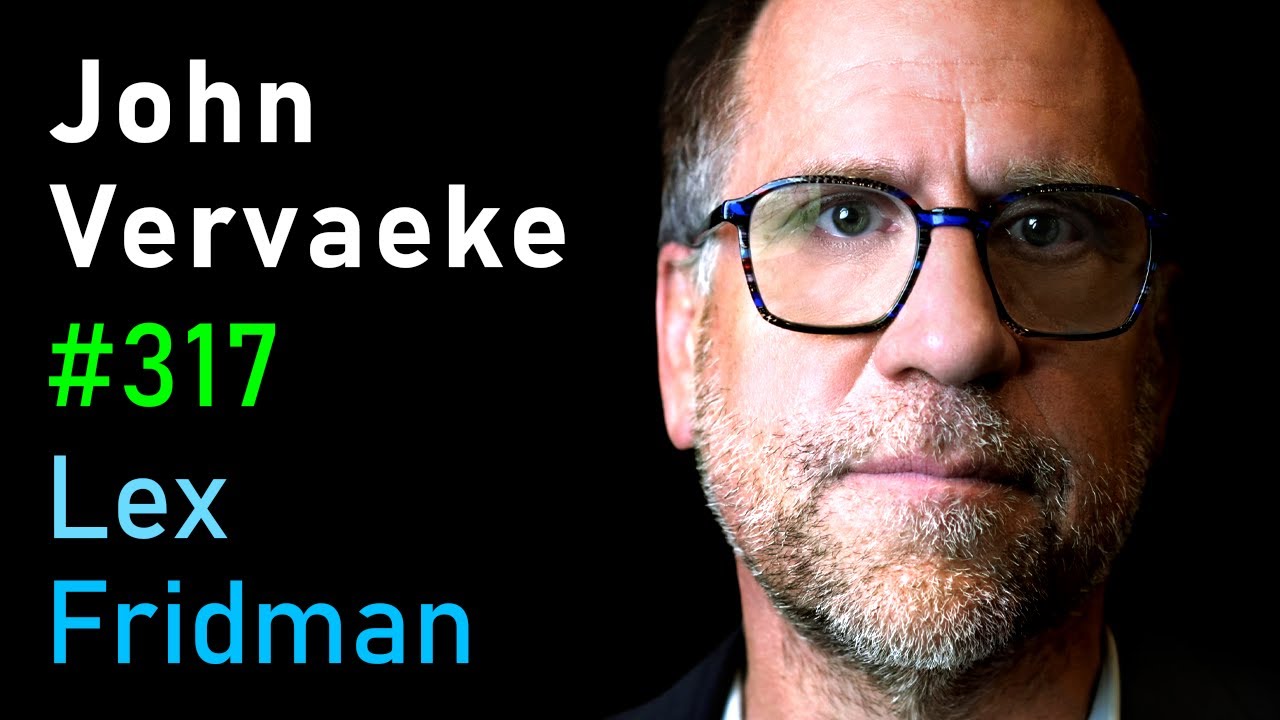
John Vervaeke — A psychologist and cognitive scientist at the University of Toronto, known for his 50-part lecture series 'Awakening from the Meaning Crisis.' He works in 4E cognitive science on relevance realization, wisdom, mindfulness, and the meaning crisis.
The gist
Lex Fridman and John Vervaeke explore what makes life meaningful, framing meaning not as a property of the self or the universe but as a 'transjective' relationship between them. Vervaeke unpacks his core ideas—relevance realization, multiple ways of knowing, wisdom as overcoming self-deception, and flow as optimized non-propositional connectedness. The conversation ranges across mortality, consciousness, AGI, atheism versus non-theism, psychedelics, mindfulness practices, and the religion-as-psychotechnology thesis. It closes with the rise and danger of pseudo-religious ideologies like Marxism and Nazism, the nature of evil and sin, and Vervaeke's own dark passage out of fundamentalist Christianity.
Big reveals
- Vervaeke reframes mortality as a present-tense state, not a future event—the universe's indifference is always with us.
- States plainly that mind and life go away completely when we die, and that this finitude matters morally.
- Declares himself a 'non-theist,' rejecting the shared presuppositions of both theists and atheists.
- Warns that video-game flow can hijack real-world flow and is linked by the WHO to disorder and depression.
- Reclaims 'sin' as a failure to love wisely—a deeper category than individual immorality.
- Reveals his own years-long 'black burning'—a dark, self-destructive period after leaving fundamentalist Christianity.
- Claims people who have mystical/higher states of consciousness show measurable, lasting increases in openness and well-being.
Things worth remembering
- In surveys people rank public speaking above death as their greatest fear, because loss of status feels like a kind of death.
- Terror-management word-priming makes people rigid in third person, but more cognitively flexible when imagining dying in first person.
- The fastest-growing religious demographic is the 'nones'—mostly 'spiritual but not religious,' not atheist.
- On the Wason selection task only ~10% of individuals succeed, but groups of four reach an 80% success rate.
- Psychedelics may work like neural-network 'dropout'—reducing constraints and preventing overfitting so the brain generalizes better.
- Flow requires clear information, tightly coupled feedback, and consequences where failure matters—the same conditions as a scientific experiment.
- Vervaeke distinguishes four kinds of knowing: propositional, procedural, perspectival, and participatory.
- Meditation means stepping back to look AT your mental frame; contemplation means looking THROUGH it—mindfulness is both.
- He frames Marxism and Nazism as pseudo-religious ideologies fueled by a 'Promethean spirit' that licenses any means.
Recommended in this episode
Books, products and media the guest or host genuinely endorsed here — with the buy link.
Affiliate link — we may earn a commission at no extra cost to you.
The Oxford Handbook of Spontaneous Thought
Kalina Christoff and Kieran C. R. Fox
“the article we published in the hand the Oxford handbook spontaneous thought with Aryan Hera Bennett and Leo Ferraro” — John Vervaeke 02:15:39Find it on Amazon