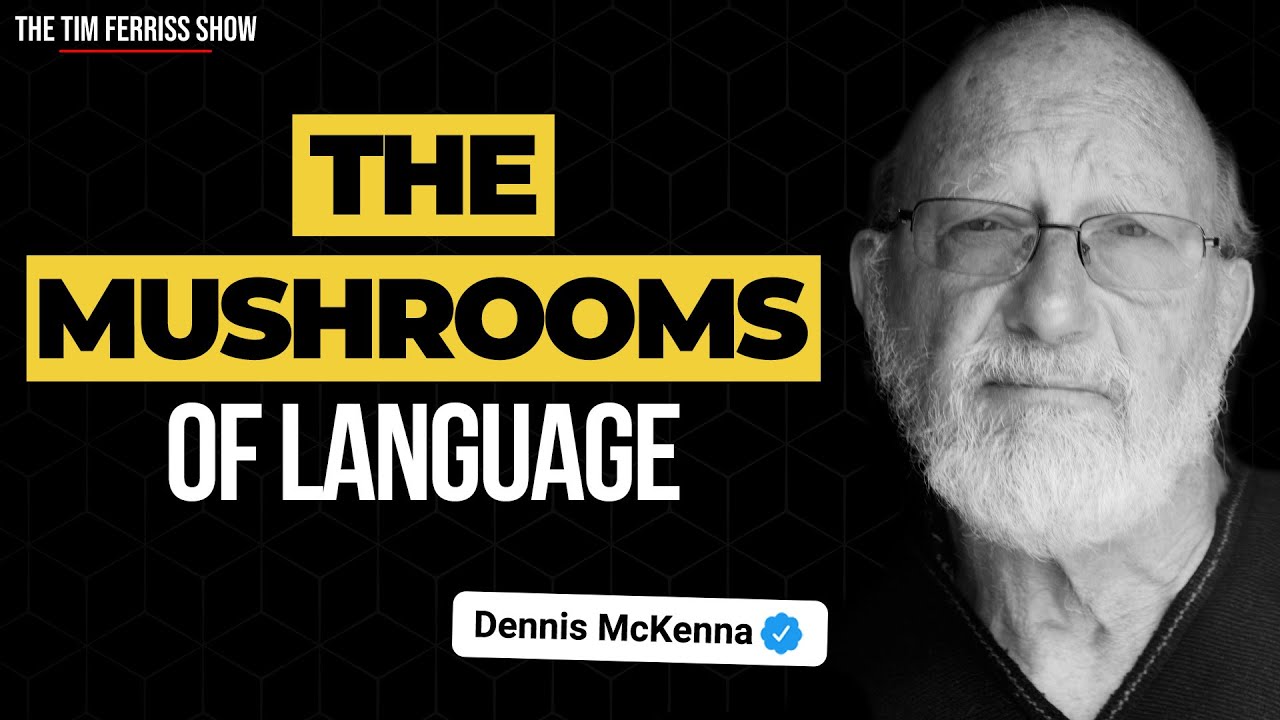
Dennis McKenna — Ethnopharmacologist with 40+ years researching Amazonian plant hallucinogens; founding board member of the Heffter Research Institute, founder of the McKenna Academy of Natural Philosophy, and younger brother of Terence McKenna.
The gist
In this second Tim Ferriss conversation, Dennis McKenna explores the 'strange and weird' edges of psychedelic science, from titrating DMT and smoking ayahuasca vine bark to why some people feel nothing from massive doses. He explains how neurotransmitter-like compounds such as DMT are ubiquitous across plants, fungi, and animals due to shared evolutionary origins, and shares the bizarre story of a psilocybin-producing fungus that turns cicadas into 'sex-crazed zombies.' Much of the talk centers on the conservation crisis facing endangered psychedelic plants like peyote, ayahuasca, and iboga, and McKenna's proposal to bring medicines to people rather than people to medicines. He also promotes the ESPD55 conference and his Biognosis project to preserve Amazonian ethnobotanical knowledge, and reflects candidly on mortality, the 'stoned ape' theory, and the rampant infighting and power abuse within the psychedelic community.
Big reveals
- McKenna describes discovering 'vegetable television' — smoking Banisteriopsis caapi bark while on mushrooms produced gentle, controllable waves of closed-eye visions you could titrate up and down 'like going up and down in a balloon.'
- Some people feel absolutely nothing from DMT no matter how much they smoke, while others insensitive to DMT are highly sensitive to 5-MeO-DMT — a mystery McKenna says was never solved.
- DMT is an endogenous ligand found in high amounts in the frontal cortex (not primarily the pineal gland as once thought), and 'nature is drenched in DMT' because it's only two steps from tryptophan.
- The fungus Massospora infects cicadas, replacing their abdomens with spore masses and dosing them with psilocybin and cathinone, turning them into hypersexual 'sex-crazed zombies' that spread spores.
- On death, McKenna says the only honest scientific answer is 'nobody knows' — near-death experiences aren't actual death — and he takes a leaf from end-of-life psilocybin patients: 'we're all dying... important thing is we're alive now.'
- Ayahuasca, peyote, and iboga are endangered (iboga 'on the verge of extinction'), and McKenna proposes bringing medicines north via indigenous-produced, legal channels rather than sending 'rich gringos' to South America.
- McKenna calls the psychedelic community a 'psychedelic infighting Olympics,' explaining that any spiritually powerful technology attracts power-mad people — 'usually it's about the chicks and the money.'
- A respected shaman told McKenna there are two kinds of people he'd never give ayahuasca to: schizophrenics and sociopaths, because it won't help either — and may make them worse.
Things worth remembering
- Western scientists long dismissed wild pepper added to curare as 'primitive superstition' until discovering compounds like piperine increase bioavailability, making the poison faster-acting so monkeys fall before their tails grip a branch.
- Combining MAO inhibitors with psilocybin mushrooms multiplies their subjective intensity roughly 3–4x — 1.5g feels like ~4.5g — but smoking the vine bark lets you titrate the effect instead of being locked in.
- Psilocybin has existed for at least 75 million years, long before animal nervous systems, and likely evolved as an insect attractant.
- Cordyceps fungi infect ants and direct them to climb a blade of grass to the optimal spore-dispersal height before killing them and exploding spores from their heads.
- McKenna calls ordinary consciousness 'the reality hallucination' and cites Huxley's 'reducing valve' — psychedelics disable the default mode network's filtering, letting people step outside their reference frame.
- Albert Hofmann, who first synthesized LSD, had numerous spontaneous mystical experiences in nature long before ever taking the drug.
- The original 1967 ESPD conference (Ethnopharmacologic Search for Psychoactive Drugs), sponsored by NIMH, produced only a book for taxpayers; promised follow-ups never happened until McKenna revived it 50 years later.
- The ESPD50 conference livestream drew up to 75,000 participants at times.
- Peyote (Lophophora williamsii) can take 10–20 years to grow a mature button even in greenhouses, making volume constraints severe regardless of cultivation method.
- The Biognosis project aims to digitize the Iquitos herbarium's ~100,000 specimens and build a VR 'visionary rainforest,' likely costing several million dollars.
Recommended in this episode
Books, products and media the guest or host genuinely endorsed here — with the buy link.
Affiliate link — we may earn a commission at no extra cost to you.
The Brotherhood of the Screaming Abyss
Dennis McKenna
“I thought we could start with a number of excerpts, highlights that I grabbed from The Brotherhood of the Screaming Abyss, which chronicles many of your life experiences” — Tim Ferriss 00:03:38Find it on Amazon
Bicycle Day
Brian Blomerth
“There's a wonderful book. I like to plug books. You've probably read it called Bicycle Day by Brian Blomers. It's a graphic novel.” — Dennis McKenna 00:51:53Find it on Amazon
The Mind of a Mnemonist: A Little Book About a Vast Memory
A. R. Luria
“there are two resources I want to recommend. The first is a book that I first bought in late high school called The Mind of a Mnemonist.” — Tim Ferriss 00:52:26Find it on Amazon
ESPD 50 box set (Ethnopharmacologic Search for Psychoactive Drugs)
Dennis McKenna
“the box set of books for ESPD 50, you can find online. You can find them on Amazon. They're beautifully done. I have them on my bookshelf.” — Tim Ferriss 00:59:42Find it on Amazon