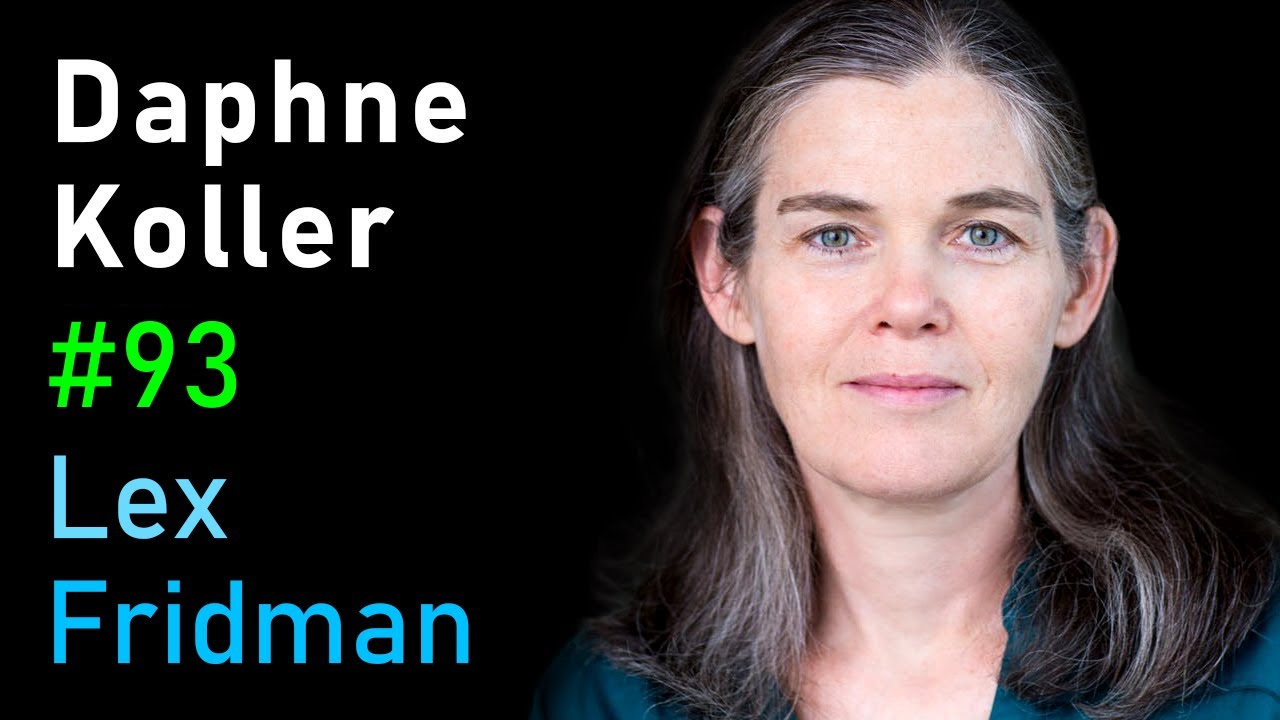
Daphne Koller — Stanford computer science professor, co-founder of Coursera with Andrew Ng, and founder/CEO of Insitro, a company applying machine learning to biomedicine and drug discovery.
The gist
Daphne Koller joins Lex Fridman to discuss the intersection of machine learning and biomedicine. She describes how Insitro flips the usual approach by deliberately generating high-quality, large-scale biological data sets so machine learning can build predictive models for drug discovery. Much of the conversation centers on 'disease in a dish' models built from induced pluripotent stem cells, the limits of animal models, and which diseases are most tractable. She also reflects on the origin and lessons of Coursera and the MOOC revolution, the importance of uncertainty calibration in ML, the feasibility and risks of AGI, and what gives life meaning.
Big reveals
- Koller estimates that for the majority of major diseases our understanding of mechanisms is 'really close to zero,' with Alzheimer's closer to zero than to 80.
- She argues Alzheimer's, schizophrenia, and type 2 diabetes are not single diseases but heterogeneous collections of mechanisms, like breast cancer.
- Insitro's contrarian thesis: instead of doing ML on whatever data exists, deliberately engineer data sets designed for machine learning.
- Her interest in drug discovery was catalyzed by her father's death from an autoimmune lung disease for which prednisone was the only treatment.
- She explains 'disease in a dish' models, noting mice don't naturally get Alzheimer's, diabetes, atherosclerosis, autism, or schizophrenia, so animal cures rarely translate.
- She warns many self-taught ML practitioners skip foundations and end up running models that are simply wrong without realizing it.
- Koller says today's ML can't match even a human toddler's flexibility and is not worried about machines taking over to gain power.
- She argues gene editing and CRISPR are at least as dangerous as machine learning if used badly, e.g. creating nasty viruses.
Things worth remembering
- For most non-childhood diseases, the risk of contracting them rises exponentially every year from about age 40.
- Koller's health-span aspiration is living to the biblical 120 in high quality of life rather than literal immortality.
- Reverting a skin cell back to stem-cell status is now 'almost industrialized,' done by contract research organizations.
- She estimates only about five to ten thousand induced pluripotent stem cell lines existed in the world at the time.
- Polygenic risk scores can show disease-risk differences of a factor of 10 or 12 between the highest and lowest deciles.
- The first Stanford MOOCs launched in fall 2011 and drew about 100,000+ students each within weeks, sparked by a viral New York Times article.
- Coursera found video modules of 5 to 7 minutes work better than 15-minute ones for busy adult learners.
- A/B testing online showed a female instructor role model can shift the gender balance of students in STEM courses.
- Koller notes neural networks often grow more confident and more wrong the further inputs stray from training data, a danger in medical diagnosis.
- Inspired by a Steve Jobs quote, she says life's goal should be to 'make a dent in the universe' and leave the world better.