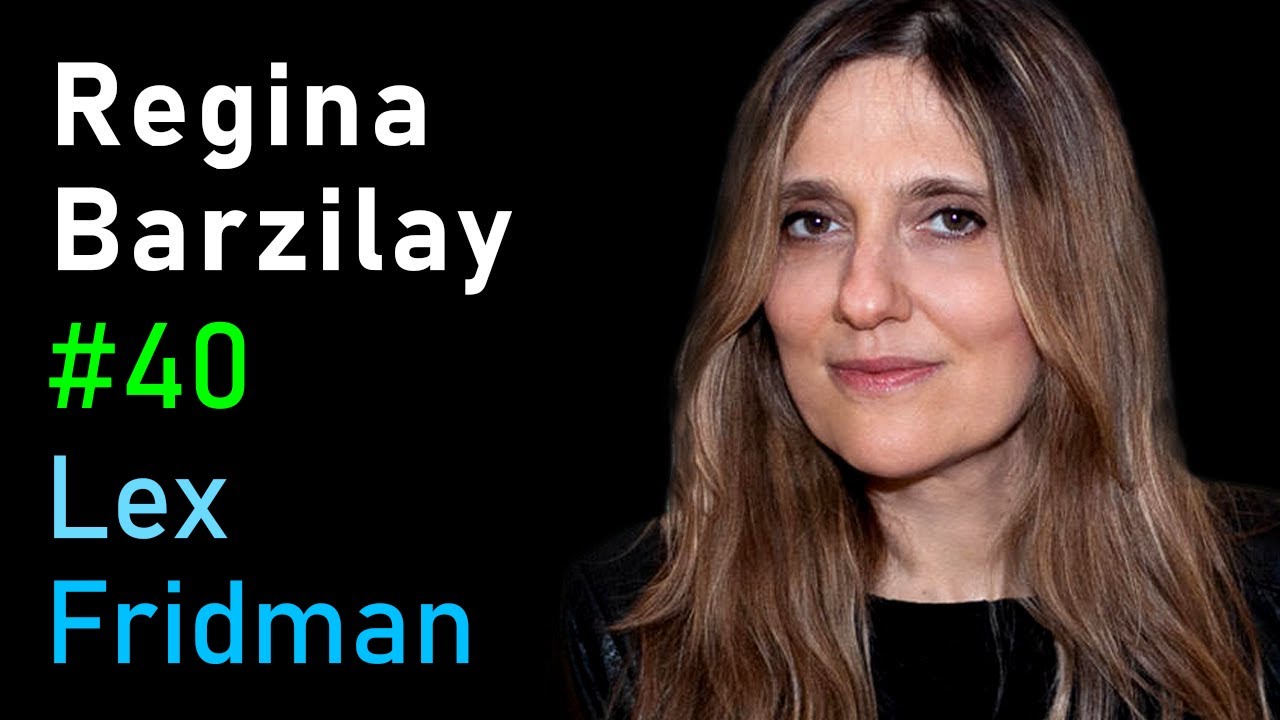
Regina Barzilay — MIT professor and world-class NLP researcher applying deep learning to chemistry and oncology for early cancer diagnosis, prevention, and treatment. A breast cancer survivor herself, she also teaches MIT's popular intro machine learning courses.
The gist
Regina Barzilay discusses how her 2014 breast cancer diagnosis reoriented her research toward problems that alleviate real human suffering. She explains how machine learning can predict and detect cancers like breast and pancreatic far earlier than current statistical models, and why the biggest obstacles are not algorithms but data access, regulation, and adoption. The conversation covers AI-driven drug design over molecular graphs, the diminished role of linguistics in modern NLP, and whether deep learning can ever achieve true language understanding. She closes on augmenting human cognition and finding personal meaning beyond external recognition.
Big reveals
- Barzilay reveals she was 43 when diagnosed with breast cancer and realized for the first time in her life that she might die.
- Returning to MIT after treatment, she saw her field's work as trivial: people building careers on improving parsers by two or three percent.
- She argues computer scientists wrongly assumed treating diseases was someone else's job and must join the battle.
- There is no publicly available dataset of modern mammograms in the US; it took her two years to get access to data.
- Breast density risk assessment is a 2019 federal law, yet ~40-50% of women have dense breasts, making the 'high risk' label nearly meaningless.
- She states there is currently no drug developed by an ML model, calling drug design a wide-open frontier.
- She recounts the ELIZA story: MIT secretaries spent hours confiding in a trivial string-matching program, horrifying its creator Weizenbaum.
Things worth remembering
- There are roughly 1.7 million new US cancer cases and 600,000 cancer-related deaths every year.
- Most pancreatic cancer is detected when incurable, with only a few percent surviving five years; early detection can change that.
- About 80% of breast cancer patients are the first in their families to get it, undermining the idea it is mainly inherited.
- The breast density heuristic dates to 1967, when radiologist Wolfe eyeballed mammograms to spot patterns later coded into four categories.
- In drug design, a small molecule is treated as a graph where nodes are atoms and edges are bonds.
- Barzilay notes statistical methods so dominated NLP that the role of linguistics greatly diminished.
- ELIZA used only trivial string matching and rephrasing with no syntax, yet people believed it understood them.
- She admits keeping a gym-app status streak for 18 months, even doing a huge workout right after an injury to avoid losing it.
Recommended in this episode
Books, products and media the guest or host genuinely endorsed here — with the buy link.
Affiliate link — we may earn a commission at no extra cost to you.
Flowers for Algernon
Daniel Keyes
“coming back to another book that I love flowers for algernon have you read this book” — Regina Barzilay 01:04:30Find it on Amazon