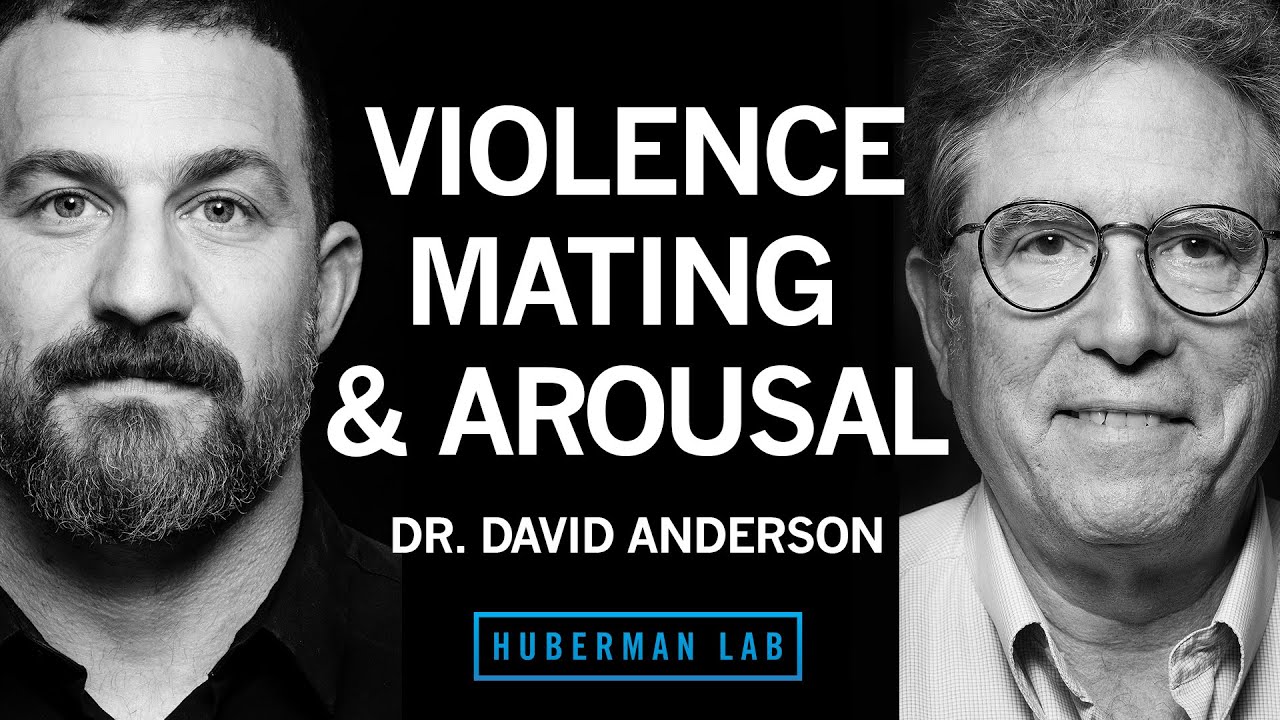
Dr. David Anderson — Professor of biology at Caltech, member of the National Academy of Sciences, and Howard Hughes Medical Institute investigator since 1989. A pioneer in the neurobiology of emotions, internal states, aggression, fear, and mating circuits, and author of 'The Nature of the Beast.'
The gist
Andrew Huberman interviews Caltech neurobiologist David Anderson about the biology of emotions, which Anderson frames as internal states governed by neural circuits rather than just subjective feelings. They explore how aggression, fear, mating, feeding, and temperature regulation neurons are densely intermingled in tiny hypothalamic regions like the VMH and medial preoptic area, often using optogenetics in mice. Anderson explains counterintuitive findings: estrogen and progesterone (not just testosterone) drive male aggression, female mice switch from mating to aggression after having pups, and male-male mounting is usually dominance rather than sexual. The conversation covers how social isolation massively upregulates the neuropeptide tachykinin to increase aggression and anxiety, and how a shelved drug (osanetant) reverses this in mice. Anderson laments pharmaceutical companies' economic disincentives to retest abandoned drugs and closes on the brain-body connection via the vagus nerve.
Big reveals
- Anderson reveals brain-stimulated aggression failed in mice for 50 years with electrical current; only optogenetics worked, because the tiny VMH's fear neurons sit atop aggression neurons and electricity activated both.
- Offensive aggression is rewarding to male mice; they will press a bar for the chance to beat up a subordinate male and prefer the compartment where aggression neurons are activated.
- The aggression-controlling neurons in male mice are marked by the estrogen receptor, and you can restore a castrated mouse's fighting with an estrogen implant instead of testosterone.
- Female mice only become hyper-aggressive after delivering pups, with a neuronal seesaw flipping mating-dominant in virgins to fighting-dominant in mothers.
- Most male-male mounting is dominance, not sexual; the tell is ultrasonic song, which males sing when mounting females but not when mounting males.
- Two weeks of social isolation causes a massive upregulation of Tachykinin-II in the mouse brain, driving increased aggression, fear, and anxiety.
- The abandoned drug osanetant lets a socially isolated, normally lethal mouse be returned to its cage-mates without killing them, leaving it 'chill' but not sedated.
- Anderson recounts pharma companies refusing to retest safe, shelved neuropeptide drugs because a single Phase 3 failure costs $100 million and creates 'once burned, twice shy' aversion.
Things worth remembering
- Persistence distinguishes emotions from reflexes: a rattlesnake startle keeps your heart pounding and palms sweating long after the snake is gone.
- The VMH controls the 'four Fs'—feeding, freezing, fighting, and mating—plus body metabolism; destroying it in a rat produces a fat rat.
- A mouse with stimulated mating neurons won't act until a target appears, then will try to mount even a kumquat—'any port in the storm.'
- Aromatase inhibitors used as breast cancer chemotherapy block testosterone-to-estrogen conversion; giving them to male animals stops both fighting and sexual activity.
- In the medial preoptic area there are 'make-love-not-war' neurons; stimulating them mid-fight makes a male stop attacking and start singing to and mounting his opponent.
- Anderson speculates summertime violence spikes may tie thermoregulatory neurons to aggression, echoing phrases like 'in heat' and 'hothead.'
- Fear-induced analgesia suppresses pain during danger; a 22-amino-acid bovine adrenal medullary peptide acts as an endogenous painkiller.
- Neuropeptides are evolutionarily conserved: Neuropeptide Y controls feeding in worms, flies, mice, and people; tachykinins control aggression across species.
- Tachykinin-I is Substance P; Tachykinin-II in humans is called Neurokinin B.
- The 'somatic marker hypothesis' from Antonio Damasio links subjective emotional feelings to sensations in specific body parts like the gut and heart.
Recommended in this episode
Books, products and media the guest or host genuinely endorsed here — with the buy link.
Affiliate link — we may earn a commission at no extra cost to you.
The Nature of the Beast: How Emotions Guide Us
David Anderson
“Dr. Anderson is an author of a terrific new popular book, entitled "The Nature of the Beast: How Emotions Guide Us". I've read this book several times now” — Andrew Huberman 00:01:33Find it on Amazon
The Nature of the Beast: How Emotions Guide Us
David Anderson
“whether or not you're a therapist, or you're a biologist, or you're simply just somebody interested in why we feel the way we feel and why we act the way we act, I cannot recommend the book highly enough” — Andrew Huberman 00:01:33Find it on Amazon