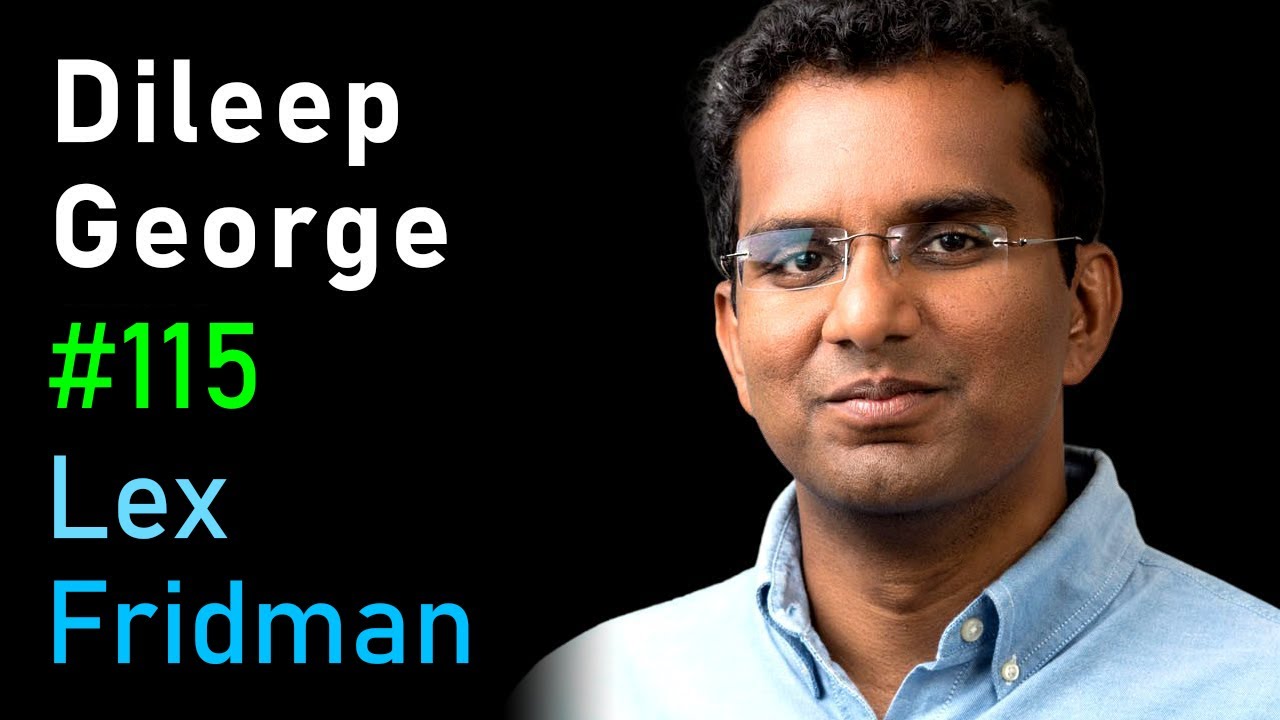
Dileep George — Researcher at the intersection of neuroscience and AI, co-founder of Vicarious (with Scott Phoenix) and formerly Numenta (with Jeff Hawkins and Donna Dubinsky). Known for hierarchical temporal memory and the Recursive Cortical Network.
The gist
Dileep George explains why understanding the brain is essential to building intelligence, critiquing projects like Blue Brain that simulate neurons without a functional theory. He details the Recursive Cortical Network, a graphical-model approach to vision that uses feedback and lateral connections to do dynamic inference, famously cracking text CAPTCHAs with little training data. He argues perception and cognition are inseparable and that concepts are learned through grounded simulation before language. He is skeptical that scaling models like GPT-3 yields real world understanding, since text lacks the information present in physical, interactive experience. The conversation closes on memory, brain-computer interfaces, consciousness, mortality, and book recommendations.
Big reveals
- George argues the Blue Brain project cannot work because simulating ever more neuronal detail without a functional theory leaves you unable to debug or explain it.
- He compares getting a single neuron model right to getting a transistor right: it still won't tell you how to build a microprocessor.
- After his RCN paper was accepted, Science's own press office spun it as 'a new deep learning model solves captchas' despite the paper explicitly being a non-deep-learning graphical model.
- His core thesis: language is simulation control, and the perceptual plus motor system builds the actual simulation of the world.
- George insists scaling GPT cannot produce AGI because the needed commonsense information simply isn't present in text.
- He flatly disagrees with Chomsky 'completely,' rejecting universal grammar in favor of pre-language grounded concepts.
- He argues death/mortality may be a fundamental property of intelligence and is why he isn't worried about AI wanting to kill humans: it would just wait us out.
- The Wright brothers learned from birds that flapping/propulsion wasn't the key problem to solve, control was.
Things worth remembering
- A famous paper, 'Could a neuroscientist understand a microprocessor,' showed standard neuroscience tools fail to reveal how a chip works.
- The visual cortex has far more feedback connections than feed-forward connections.
- In the Kanizsa triangle illusion, neurons fire later for the hallucinated illusory edge than for a real edge, evidence of feedback.
- You've seen the Google logo countless times yet can't recall the color of the letter 'e,' showing the brain's model isn't photorealistic.
- A five-year-old can solve any brand-new CAPTCHA style with zero training examples, something deep learning still cannot do.
- Hofstadter said the central problem in AI is recognizing the letter 'A' in all its forms, which requires commonsense understanding.
- The visual cortex is not convolutional; convolution is an engineering trick that will fade once robots have moving eyes and heads.
- Asking whether a nail pounded into the ceiling is horizontal or vertical is answered by mentally simulating the scene, not from text.
- The company name 'Vicarious' refers to running the world's models in your mind, and turning that modeling on yourself gives rise to consciousness.
Recommended in this episode
Books, products and media the guest or host genuinely endorsed here — with the buy link.
Affiliate link — we may earn a commission at no extra cost to you.
Probabilistic Reasoning in Intelligent Systems
Judea Pearl
“i definitely liked uh judy apple's book uh probabilistic reasoning and intelligence systems it's um it's a very deep technical book but what i liked” — Dileep George 01:58:21Find it on Amazon
The Book of Why
Judea Pearl
“the book of why is definitely more enjoyable oh for sure yeah um so yeah so i would i would recommend probabilistic reasoning in intelligent systems” — Dileep George 01:59:24Find it on Amazon
The Mind's I
Douglas Hofstadter and Daniel Dennett
“another book i liked uh was uh one from doug huff starter uh this is a long time ago though here's a book he had a book i think called it was called the mind's eye” — Dileep George 01:59:24Find it on Amazon
The Bishop's Boys
Tom Crouch
“the third one uh i would definitely recommend reading is um uh this is not a technical book it is history it's called it's the name of the book i think is bishop's voice it's about wright brothers” — Dileep George 01:59:54Find it on Amazon