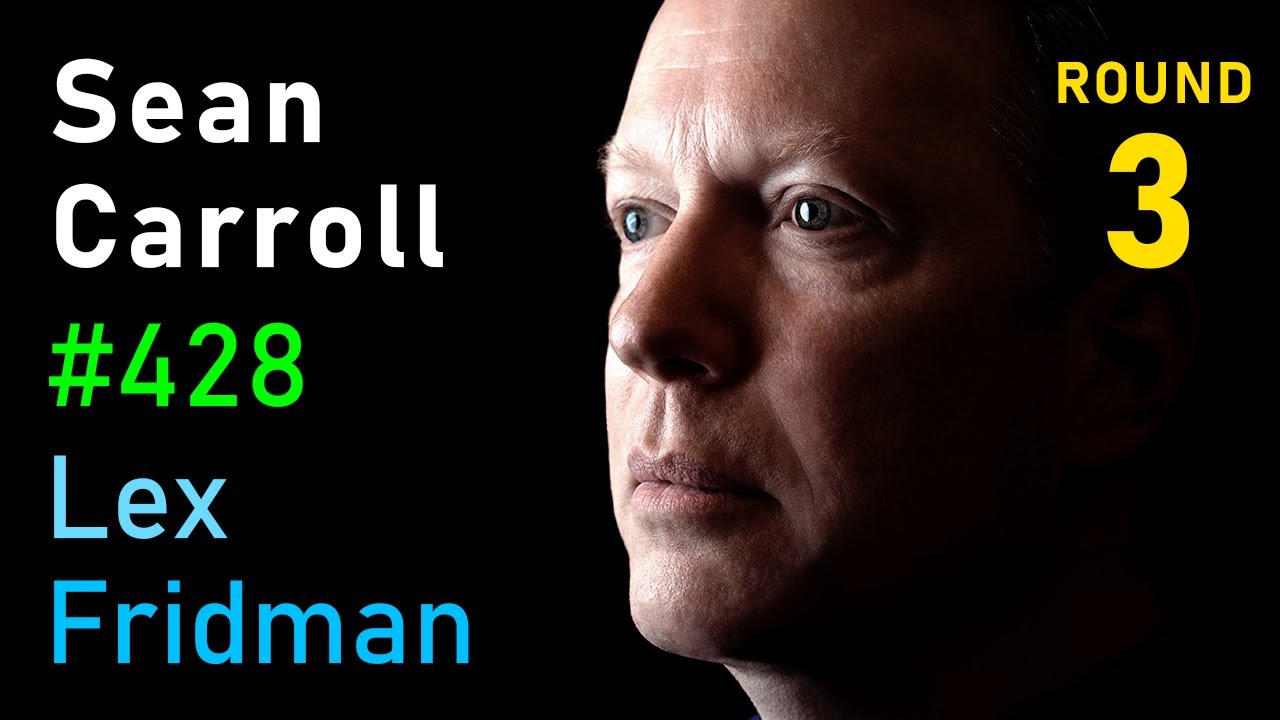
Sean Carroll — Theoretical physicist at Johns Hopkins, host of the Mindscape podcast, and author of books including 'The Biggest Ideas in the Universe' series. He is both an active researcher and one of the most celebrated communicators of physics.
The gist
Sean Carroll joins Lex Fridman for his third appearance to explore the foundations of modern physics in accessible terms. They cover Einstein's path from special to general relativity, how black holes work, the information loss puzzle, and the holographic principle, including Carroll's own neutrino-based attempt to test it against IceCube data. The conversation moves through dark matter and dark energy (including Carroll's three most-cited papers), the many-worlds interpretation of quantum mechanics, and the Big Bang. It closes with extended discussion of complexity, entropy, the limits of large language models versus human intelligence, panpsychism, poetic naturalism, and Carroll's own writing and podcasting process.
Big reveals
- A black hole is best understood not as an object but as a region of spacetime you cannot leave without exceeding the speed of light; its singularity lies in your future as a moment of time, not at a point in space.
- Hawking showed black holes radiate and eventually evaporate, creating the information loss puzzle; most physicists believe the information is transferred to the Hawking radiation rather than destroyed, but it remains unsolved.
- The holographic principle holds that the maximum information in a region scales with the area of a black hole's event horizon, not its volume, implying spacetime information is encoded one dimension lower than expected.
- Carroll and collaborator Oliver Friedrich made a specific prediction that high-energy neutrinos from across the universe should disappear due to overlapping quantum states; IceCube's data runs out exactly where their predicted cutoff sits.
- In the many-worlds interpretation, the wave function never collapses; instead you entangle with the system and split into separate non-interacting branches, and Everett's insight was that you misidentify yourself in the Schrodinger equation.
- The worlds of many-worlds do not exist somewhere in space; rather, space exists separately inside each world, with the technical home being Hilbert space.
- Most of the entropy in the universe today is in black holes: the single black hole at our galaxy's center has entropy around 10^90, more than the entire observable universe had (10^88) before stars and black holes formed.
- Carroll argues against framing progress as 'AGI,' contending artificial intelligence is fundamentally different from human intelligence and that judging AI against humans both misleads and obscures its real capabilities and dangers.
Things worth remembering
- In his 1905 'miracle year,' Einstein wrote three papers on wildly different subjects (special relativity, Brownian motion proving atoms exist, and the photoelectric effect inventing photons), any one of which would have made him famous.
- Einstein never figured out black holes; Schwarzschild derived the solution in 1917, but no one recognized it as a black hole until the 1950s with David Finkelstein and others.
- For a black hole about the mass of the sun, it takes only about a millionth of a second to fall from the event horizon to the singularity.
- Carroll cites von Neumann's point that self-reproducing probes could fill the galaxy without traveling near light speed, since the galaxy is only tens of thousands of light years across and billions of years old.
- The IceCube experiment in Antarctica drills holes about a kilometer deep and uses a cubic region of transparent ice studded with 360-degree photodetectors to catch flashes from neutrinos.
- Critics who say dark matter and dark energy mean physicists 'lost their minds' would have had to say the same when Neptune was discovered, as it was effectively the first successful detection of 'dark' matter via its gravity.
- The leading candidate for dark energy is Einstein's cosmological constant; data require it to be at least 98% constant, and a strictly 100% constant fits perfectly.
- An Othello-playing neural network appeared to internally reconstruct the game board from raw move data, but Melanie Mitchell's group found at least half that apparent understanding was actually built into the analysis probe itself.
- Malcolm MacIver theorizes that when fish first moved onto land, suddenly being able to see far (rather than only meters underwater) opened a new mode of reasoning enabling counterfactual thinking and imagination.
- Carroll argues life does not fight the second law of thermodynamics; we are 'surfers riding the wave of increasing entropy,' maintaining stability dynamically by burning low-entropy fuel.
Recommended in this episode
Books, products and media the guest or host genuinely endorsed here — with the buy link.
Affiliate link — we may earn a commission at no extra cost to you.
The Biggest Ideas in the Universe
Sean Carroll
“author of many books, including the most recent book series called "The Biggest Ideas in the Universe," the first book of which is titled "Space, Time, and Motion"” — Lex Fridman 00:00:32Find it on Amazon
Space, Time, and Motion
Sean Carroll
“the first book of which is titled "Space, Time, and Motion," and it's on the topic of general relativity” — Lex Fridman 00:01:03Find it on Amazon
Quanta and Fields
Sean Carroll
“the second coming out on May 14th, so you should definitely pre-order it, is titled "Quanta and Fields." And that one is on the topic of quantum mechanics” — Lex Fridman 00:01:03Find it on Amazon
Something Deeply Hidden
Sean Carroll
“You wrote the book "Something Deeply Hidden on the Mysteries of Quantum Mechanics" and a new book coming out soon” — Lex Fridman 01:11:09Find it on Amazon
Complexity and Emergence
Sean Carroll
“Book three that I'm writing right now is called "Complexity and Emergence." And that'll be the final part of the trilogy” — Sean Carroll 02:18:55Find it on Amazon