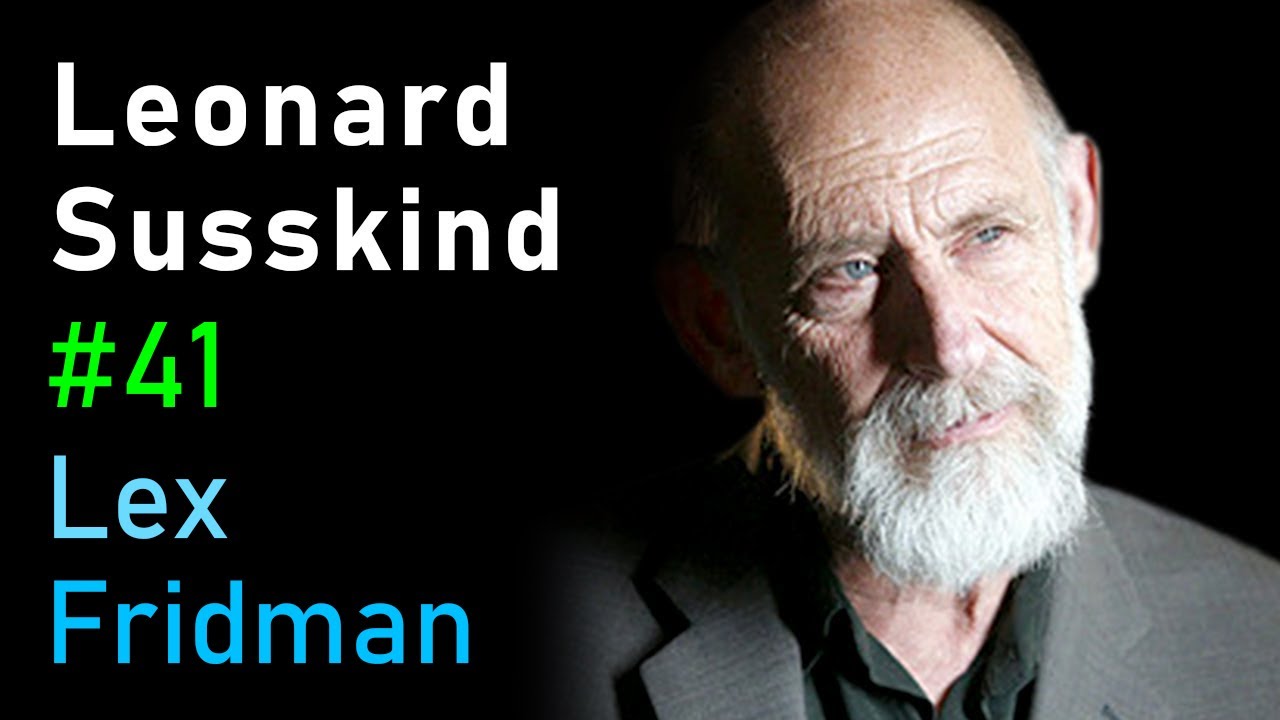
Leonard Susskind — Professor of theoretical physics at Stanford University and founding director of the Stanford Institute for Theoretical Physics. Widely regarded as one of the fathers of string theory and one of the greatest physicists of his era, both as researcher and educator.
The gist
Lex Fridman interviews physicist Leonard Susskind about how he does physics through intuition and visualization, a style validated by his friendship with Richard Feynman. They discuss quantum computers and their real power being the simulation of quantum systems, the limits of classical computers, and the relationship between large quantum computers and black holes. Susskind reflects on string theory as a tool that proved quantum mechanics and gravity can coexist consistently, the arrow of time and reversibility, and whether quantum mechanics is the bottom of the well. The conversation closes on consciousness, free will, machine learning, and whether an intelligent agent underlies the universe.
Big reveals
- Susskind says he and many physicist friends can now think more easily quantum-mechanically than classically after rewiring their brains.
- He reveals his doubts were never about ability but about feeling like a working-class outsider in academia, not learning physics existed until almost age 20.
- Argues the great power of quantum computers will be simulating quantum systems, not factoring, which he calls almost a fluke.
- Claims the physics of large quantum computers is similar to the physics of large black holes.
- Discloses a second job consulting for Google X as senior academic advisor to a group of machine learning physicists.
- Admits he once thought quantum gravity was 500 years from being understood, but real progress came in 20-25 years.
- States he cannot see past quantum mechanics and sees no reason for anything beyond it, while staying humble about it.
- Explains you can carefully reverse a small system's trajectory backward in time, but insists this is not science-fiction time travel.
Things worth remembering
- Simulating the quantum state of just 400 qubits would require more information than can be stored in the entire universe.
- Susskind says he cannot visualize even one or two dimensions without embedding them in three-dimensional space.
- Superconductors, despite seeming monstrously complicated, boil down to a simple quantum phenomenon called spontaneous symmetry breaking.
- String theory was originally invented in the late 60s/early 70s to describe hadrons, and was experimentally validated for that.
- The objects of gravitation in string theory are nineteen orders of magnitude smaller than a proton.
- Entropy and the arrow of time only emerge at the thermodynamic level with large numbers of subsystems; atoms have no sense of time's direction.
- Our universe is de Sitter space (exponentially expanding), which physicists do not understand mathematically, unlike anti-de Sitter space.
- Susskind marvels that machines taught themselves chess by playing against each other, calling it a form of evolution producing intelligence.
- He closes by posing as a real but possibly unanswerable question whether an intelligent agent is responsible for the whole universe.