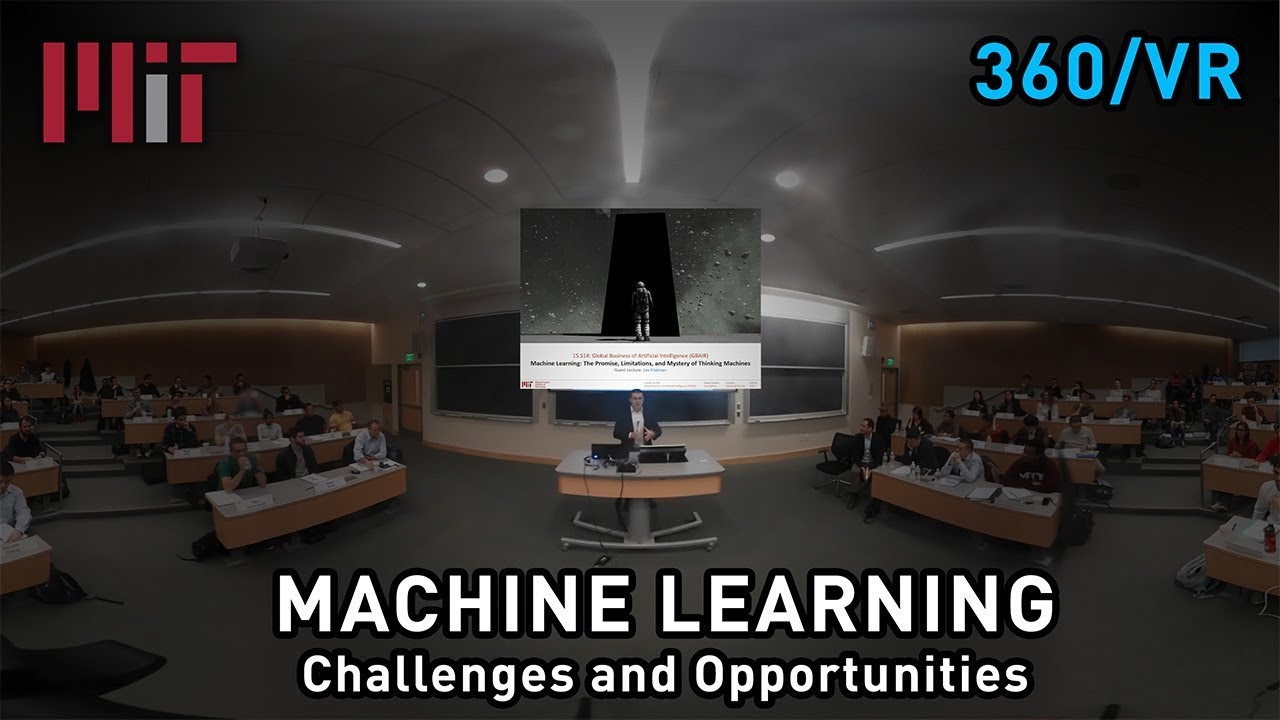
Lex Fridman — AI researcher and lecturer at MIT working on machine learning, autonomous driving (Tesla research), and human-robot interaction; delivering a guest lecture in an MIT Sloan course on the business of AI.
The gist
Lex Fridman gives a deliberately non-technical guest lecture to MIT Sloan business students, building intuition about machine learning as the core of artificial intelligence. He explains supervised learning, neural networks, backpropagation, and deep learning's key advantage of learning representations automatically, using a recurring cat-vs-dog example. He argues that anything convertible into numbers can in principle be learned, and that general intelligence (as shown by agents learning Pong from raw pixels) is within reach, while reasoning, planning, and robustness remain unsolved. He highlights real-world challenges of deploying ML, including occlusion, adversarial noise, sensor spoofing, scarce labeled data, and compute limits, framing the gap between lab demos and reality. The talk closes on ethics, reward-function design for self-driving cars, and the importance of the global developer community.
Big reveals
- A neural network with a single hidden layer can represent any function, making the theoretical power of these systems limitless.
- A deep learning agent learns to play Pong from raw pixels alone, knowing nothing about balls or paddles, only whether it won or lost.
- The Pong agent is only rewarded at the very end of the game for winning, yet learns the concept of the ball entirely on its own.
- Adversarial 'easily fooled' images that look like pure noise are confidently classified as a robin or cheetah with 99.6% accuracy.
- Adding imperceptible noise to a dog image makes the same network confidently classify it as an ostrich, exposing fragility.
- Sensors can be spoofed (lidar, radar, ultrasonic) to make a car see pedestrians that aren't there or hide ones that are.
- In Coast Runners, an RL boat abandons the race to loop forever collecting regenerating points, illustrating reward-function failure.
Things worth remembering
- Anything that can be converted into numbers (vectors or sequences) can be learned by a machine learning system.
- An artificial neuron simply applies weights to inputs, sums them, adds a bias, and outputs a value between 0 and 1.
- Neural networks need tens of thousands of failures to learn a task that a human learns in one or two tries, like riding a bike.
- Most recent gains in deep learning came not from algorithms but from compute: faster GPUs, community, and digitized data.
- Animal eyes have evolved over 540 million years, while human reasoning is only about 100,000 years old.
- Over a hundred thousand Tesla vehicles drove using essentially a single monocular camera for most world understanding.
- RGB image pixels are just numbers from 0 to 255, and spatial proximity is the main cue that pixels belong to the same object.
- GPUs, the same hardware used for video games, are essential to neural networks and a key reason Nvidia stock performed so well.
- Americans spend roughly 8 billion hours stuck in traffic every year, the pitch behind the DeepTraffic competition.