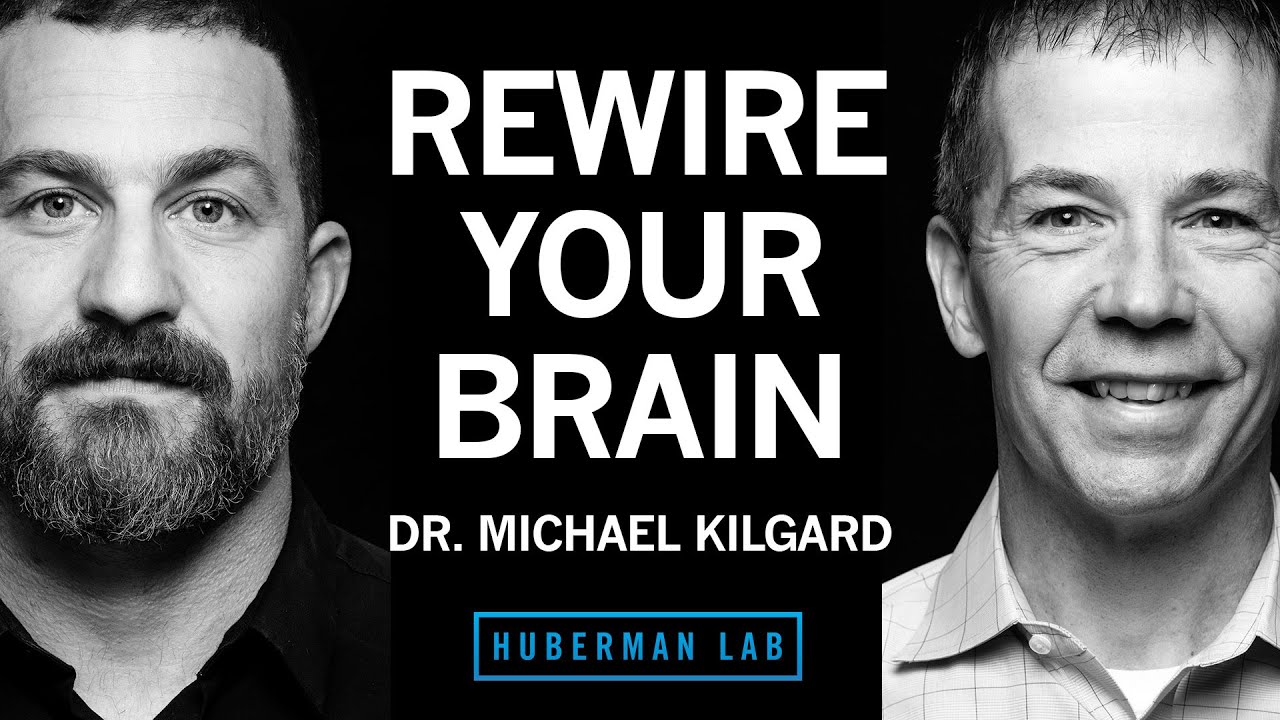
Dr. Michael Kilgard — Professor at the University of Texas at Dallas and one of the world's leading neuroplasticity researchers. In the late 1990s he and colleagues showed the adult brain can be massively rewired when neuromodulators are triggered at the right time; he now pioneers vagus nerve stimulation to treat stroke, tinnitus, PTSD, and spinal cord injury.
The gist
Andrew Huberman and Dr. Michael Kilgard explore how the brain changes across the lifespan, from childhood developmental plasticity to adult learning. They build a practical model of what plasticity requires: focus, friction (self-generated effort), reflection, and sleep, plus the timed release of neuromodulators (acetylcholine, norepinephrine, serotonin, dopamine). Kilgard explains his discovery that stimulating any of these neuromodulators paired with experience can dramatically accelerate rewiring, and how he translated this into vagus nerve stimulation devices that 'trick' the brain into a learning-ready state. They discuss FDA-approved treatments for stroke and tinnitus, clinical results for spinal cord injury and PTSD, and the limits of drugs, psychedelics, and consumer brain-stimulation gadgets. The conversation closes on optimism that complex brain disorders will yield to combination therapies of devices, drugs, and training.
Big reveals
- Neuromodulator neurons (norepinephrine, acetylcholine, serotonin) fire on novelty then quickly habituate, so the brain is always hunting the next informative thing.
- Passively exposing babies to foreign-language sounds via screens does almost nothing because the brain already knows 'that's a TV' and learning needs interaction.
- Plasticity follows a four-factor learning rule: millisecond pre/post spike timing plus a roughly two-second window of neuromodulator arrival decides strengthen, weaken, or forget.
- Kilgard's vagus nerve stimulator works by tricking the brain into thinking you're having a heart attack, releasing norepinephrine, acetylcholine, and serotonin (but not dopamine).
- FDA approved vagus nerve stimulation for ischemic stroke; in a Lancet trial patients restored hand function in just 18 days.
- SSRIs likely don't work by raising low serotonin but by inducing plasticity; depression was never proven to be a serotonin deficiency.
- A pinky-nail-sized vagus stimulator chip can be implanted in a roughly 35-minute outpatient procedure, then activated wirelessly via a neck coil like phone charging.
- Tinnitus is self-amplified by paying attention to it; chronic tinnitus affects 10-20% of people and is the number one military disability, costing about a billion dollars a year.
Things worth remembering
- The brain makes trillions of new connection decisions every second, deciding which synapses to strengthen, weaken, or leave alone.
- Each person learns roughly 100,000 words just from being in an environment, without being taught each one.
- ChatGPT has about 540 billion weights while the human brain has roughly 150 trillion synapses, making each person about 500 times larger in scale yet powered by a hamburger's worth of energy.
- Donald Hebb's 1949 'fire together, wire together' was only half right; neurons that fire slightly late get weakened (long-term depression), figured out only about 25 years ago.
- Plasticity depends on the precise timing of a transient neuromodulator release, not on how much is present.
- Cognitive behavioral therapists now claim near 100% cure rates for severe fear of heights, and standard therapy cures about 40% of PTSD cases (about 20% in military populations).
- Whether you stimulate acetylcholine, norepinephrine, serotonin, or dopamine, you get the same effect: more plasticity from fewer trials, compressing weeks of learning into days.
- A 1,500-person trial gave stroke patients Prozac; it didn't improve hand function and caused more hip fractures because serotonin is involved in bone formation.
- The likely future of treatment is a 'tripartite' approach: devices plus targeted training plus drugs, tuned to each individual.
- An inverted-U / Goldilocks effect governs neuromodulators: a little serotonin or norepinephrine enhances memory, but too much degrades it.
Recommended in this episode
Books, products and media the guest or host genuinely endorsed here — with the buy link.
Affiliate link — we may earn a commission at no extra cost to you.
Protocols: An Operating Manual for the Human Body
Andrew Huberman
“I have a brief announcement to make about my upcoming book, 'Protocols: An Operating Manual for the Human Body.'” — Andrew Huberman 00:02:04Find it on Amazon
MicroTransponder Vivistim (vagus nerve stimulator)
MicroTransponder
“I'm an inventor of, and shareholder... in a company called MicroTransponder. A little spinoff from my university, University of Texas at Dallas.” — Michael Kilgard 01:45:11Find it on Amazon
PEA (phenylethylamine)
“Confession here, I take 500 milligrams of it every morning. Makes you feel pretty good. It's a little mild stimulant. I've been doing that for years.” — Andrew Huberman 02:33:20Find it on Amazon