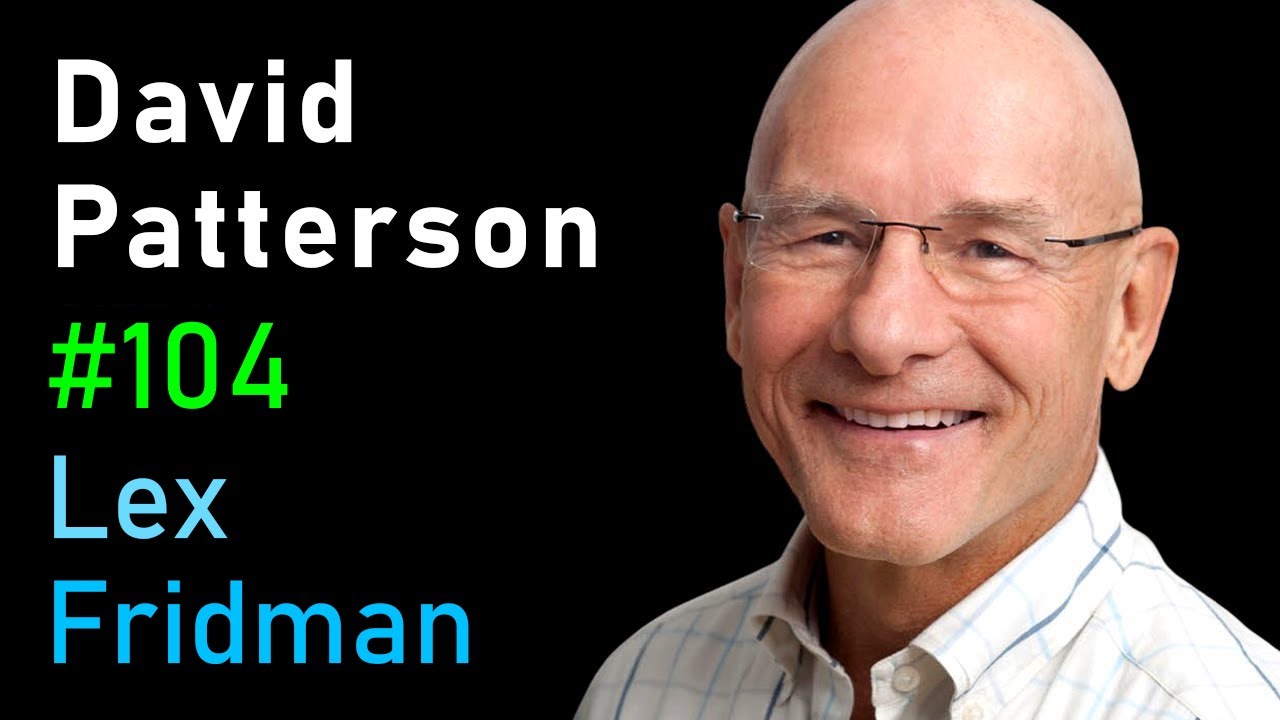
David Patterson — Turing Award-winning computer scientist and UC Berkeley professor, known for pioneering RISC processor architecture and co-creating RAID storage. Co-author with John Hennessy of the seminal textbook Computer Architecture: A Quantitative Approach.
The gist
David Patterson walks through 50 years of computer architecture, from the invention of the microprocessor and Moore's law to the contrarian RISC-versus-CISC debates of the 1980s. He explains why simple instruction sets won, how the open-source RISC-V architecture could reshape the industry, and why domain-specific accelerators for machine learning are ushering in a new golden age as Moore's law slows. He also recounts the origins of RAID storage and reflects on teaching, wrestling, and a life well-lived. Throughout, he insists Moore's law is genuinely ending despite industry marketing to the contrary.
Big reveals
- RISC executed roughly 50% more instructions but ran about four times faster, settling the violently debated RISC-vs-CISC controversy.
- Intel survived the RISC revolution by translating its complex x86 instructions into RISC-like operations in hardware on the fly.
- RISC-V's open instruction set spread accidentally after industry users complained Berkeley kept changing it, revealing huge unmet demand.
- Patterson argues general-purpose computers are barely improving and the future is domain-specific accelerators, especially for machine learning.
- Patterson directly rebuts Jim Keller, calling the claim that Moore's law isn't dead 'just marketing' and citing quantitative transistor data.
- RAID was born when an IBM reviewer warned that 40 cheap PC disks would fail every two weeks, forcing the redundancy idea.
- Patterson's secret to a 50-year marriage: the nine magic words 'I was wrong, you were right, I love you.'
Things worth remembering
- Moore's 1965 paper not only predicted doubling transistors but foresaw computers in cars and grocery-store products.
- The UNIX operating system proved you could write something as complex as an OS in a high-level language like C.
- RISC-V's core is about 40 instructions that run all software, with optional subsets you add only if needed.
- Intel processors that once doubled performance every 18 months now improve only a few percent per year.
- Machine learning's heavy reliance on matrix multiply was a 'godsend' for hardware designers who know how to accelerate it.
- Patterson helped create MLPerf, a machine-learning benchmark suite that didn't exist until about two years before the interview.
- Two national reports concluded error-corrected quantum computing is likely a decade away, around 2030.
- Storage has shifted from spinning hard disks (about 60 revolutions per second) to semiconductor flash in most devices.
- Five UC Berkeley professors who won the campus Distinguished Teaching Award are all in the National Academy of Engineering, three with Turing Awards.
Recommended in this episode
Books, products and media the guest or host genuinely endorsed here — with the buy link.
Affiliate link — we may earn a commission at no extra cost to you.
Computer Architecture: A Quantitative Approach
John Hennessy and David Patterson
“his book with John Hennessy is how I first learned about and was humbled by the inner workings of machines at the lowest level” — Lex Fridman 00:00:00Find it on Amazon
Computer Architecture: A Quantitative Approach
John Hennessy and David Patterson
“he and I wrote a textbook at the end of the 1980s called computer architecture a quantitative approach” — David Patterson 00:30:18Find it on Amazon
The Ascent of Money
Niall Ferguson
“I recommend the scent of money as a great book on this history also the audio book is amazing” — Lex Fridman 00:02:37Find it on Amazon