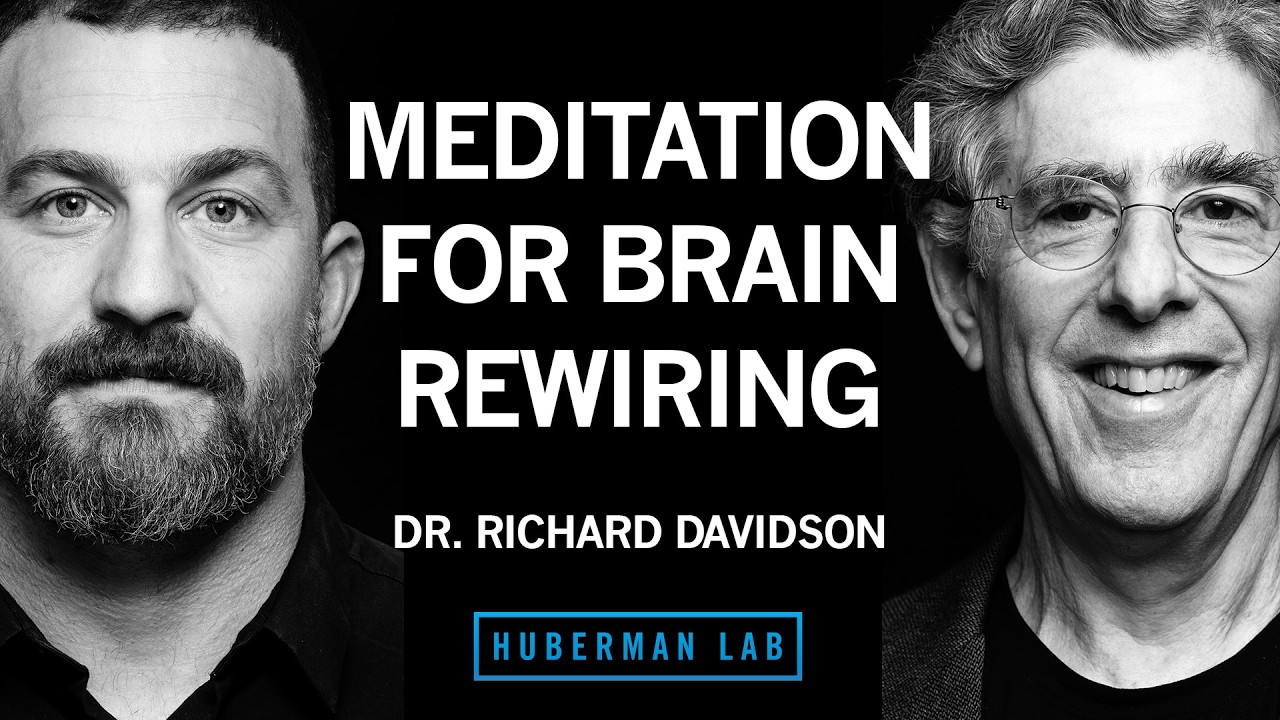
Dr. Richard 'Richie' Davidson — Professor of psychology and psychiatry at the University of Wisconsin-Madison and a pioneer in the neuroscience of meditation, having been among the first to bring brain imaging of mindfulness to the West. Author of Altered Traits and the new book Born to Flourish.
The gist
Andrew Huberman and Dr. Richard Davidson dig into the science of meditation and states versus traits of mind, arguing that how you end one mental state becomes the baseline for the next. Davidson lays out a concrete protocol—just 5 minutes a day for 30 days, formal or while walking/commuting—that produces measurable drops in depression, anxiety, stress, and the inflammatory marker IL-6, plus changes in the microbiome and brain connectivity. They reframe the discomfort of early meditation as 'lactate of the mind,' a productive stress that drives adaptation, and unpack meta-awareness, flow, the default mode network, and the four pillars of flourishing (awareness, connection, insight, purpose). The conversation also covers digital hygiene and the cognitive cost of phones, self-control as a trainable superpower, a cautious take on psychedelics, and Davidson's cutting-edge research using temporal-interference brain stimulation to boost deep sleep.
Big reveals
- Davidson says just 5 minutes of meditation a day for 30 days significantly reduces depression, anxiety, stress and the inflammatory marker IL-6—and it doesn't matter whether it's formal or done while walking or washing dishes.
- They coin 'lactate of the mind': the anxiety and chaos felt in early meditation is the stimulus for adaptation, just like muscle burn during exercise.
- An unpublished RCT of 832 Louisville teachers found students taught by teachers given well-being training scored significantly higher on standardized math tests—'flourishing is contagious.'
- Davidson admits there's been very little brain imaging on the 5-minute protocol, but what exists shows real changes in white-matter connectivity (superior longitudinal fasciculus) in a month.
- Davidson reveals he was 'terrified' of death 15 years ago but now feels he could die today having lived a fulfilling life, attributing the shift to decades of practice.
- Despite enthusiasm for psychedelic clinical trials, Davidson is openly skeptical of using psychedelics for 'normal people,' citing poorly trained one-year-certificate guides and memory-of-experience versus real embodied change.
- Davidson describes new research using transcranial electric stimulation with temporal interference (two electrodes at 15,000 and 15,001 kHz) to target deep brain structures and boost slow-wave sleep—stimulation you can't even feel.
Things worth remembering
- In 2004 Davidson's team measured long-term meditators with an average lifetime practice of 34,000 hours, seeing high-amplitude gamma oscillations visible to the naked eye in raw EEG.
- The Dalai Lama meditates roughly 4 hours every day for over 60 years—and still sleeps 9 hours a night, proudly.
- In a Science study, male undergraduates preferred to give themselves electric shocks rather than sit alone doing nothing for 15-20 minutes.
- When people start meditating there's a statistically reliable increase in anxiety in the first week—the point you're supposed to push through, not quit.
- The average American opens their phone about 152 times a day, per a recent survey.
- Cognitive performance is only normal when your phone is in another room; merely having it on the table or in your bag degrades focus because the brain burns resources suppressing thoughts of it.
- A Harvard study (Killingsworth & Gilbert) of ~3,000 people found adults' minds wander 47% of the time, and a wandering mind is an unhappy mind regardless of the activity.
- In the Dunedin, New Zealand birth cohort, kids in the top quintile of self-control at ages 4-5 later had less drug abuse, fewer legal problems, and earned ~$6,000 more per year by age 32.
- Just a few hours of loving-kindness/compassion practice over two weeks produces measurable brain changes and reduced implicit bias sustained for at least 6 months.
- Elephants have passed the mirror self-recognition test (using rouge on the trunk and an elephant-sized mirror at the Bronx Zoo).
Recommended in this episode
Books, products and media the guest or host genuinely endorsed here — with the buy link.
Affiliate link — we may earn a commission at no extra cost to you.
Born to Flourish: How New Science and Ancient Wisdom Reveal a Simple Path to Thriving
Richard Davidson and Cortland Dahl
“a new book coming out later this month entitled Born to Flourish: How to Thrive in a Challenging World, which I myself look forward to reading” — Richard Davidson 00:02:36Find it on Amazon
Altered Traits
Daniel Goleman and Richard Davidson
“my dear friend and colleague um Daniel Goleman, who I wrote the book Altered Traits with” — Richard Davidson 00:06:42Find it on Amazon
Healthy Minds Program
Healthy Minds Innovations (Richard Davidson)
“we had them use our Healthy Minds Program, which is uh a digital offering, which is freely available as the Healthy Minds Program” — Richard Davidson 01:06:52Find it on Amazon