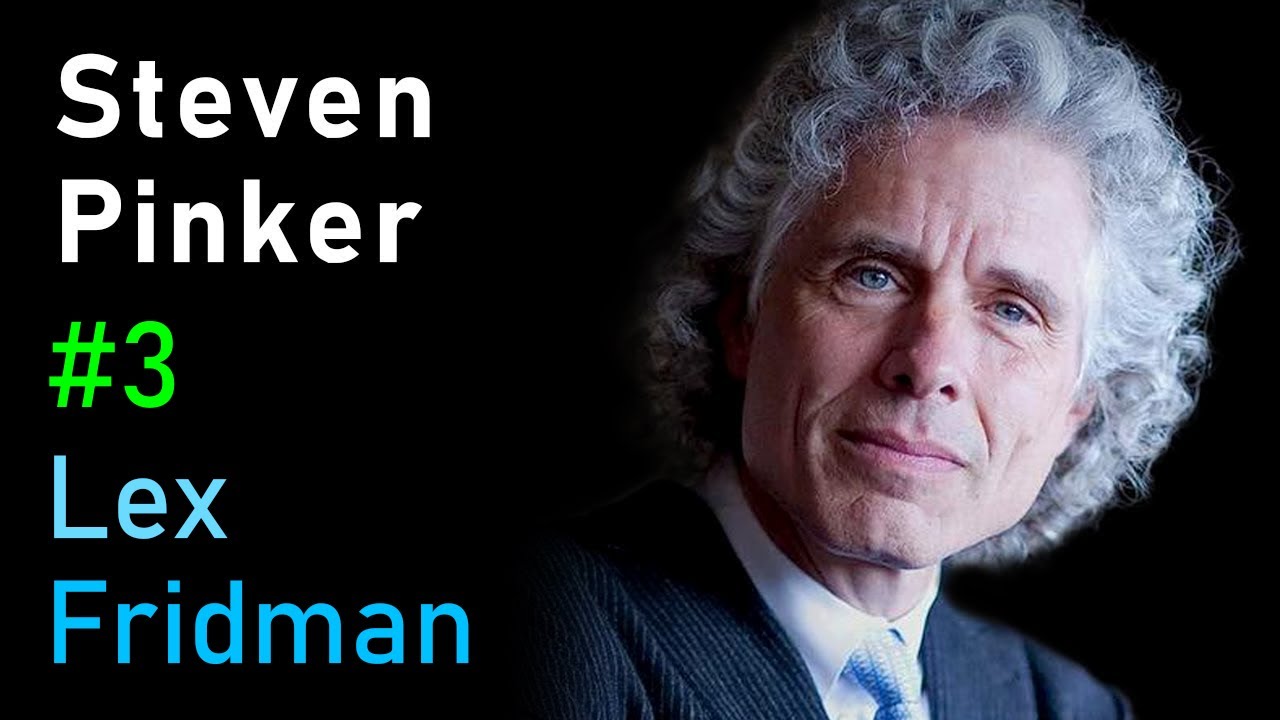
Steven Pinker — Cognitive psychologist and linguist at Harvard; bestselling author on language, the mind, violence, and reason
The gist
Lex Fridman interviews cognitive scientist Steven Pinker about the nature of intelligence, consciousness, and the meaning of life. Pinker argues that fears of AI as an existential threat, the takeover scenario and the paperclip value-alignment scenario, are incoherent because intelligence does not imply a will to power and engineers don't deploy untested all-powerful systems. He champions the safety-oriented culture of engineering and the humanitarian promise of AI, such as autonomous vehicles preventing tens of thousands of highway deaths. The conversation closes with Pinker reflecting on the books that shaped his thinking and the psychology of negativity bias.
Big reveals
- Pinker says the only truly mysterious thing about human neural networks is subjective first-person conscious experience, which he doubts we can ever know exists in machines.
- He calls both major AI existential-threat arguments incoherent: the AI-takeover fear confuses intelligence with a will to power.
- Pinker states building nuclear weapons was a massive mistake and possibly avoidable if not for World War Two.
- He argues the paperclip/value-alignment scenario is self-defeating: a system smart enough to cure cancer would not be too stupid to know we don't mean killing everyone.
- Pinker contends genuinely intelligent systems by definition weigh multiple constraints, so single-minded goal pursuit is 'artificial stupidity,' not AGI.
- Pinker reveals he will appear on Joe Rogan's podcast in a couple of weeks, and notes Rogan is concerned about AI existential threat.
Things worth remembering
- Humans are unusual among animals in acquiring knowledge to make tools, strike agreements via language, and extract poisons, letting us occupy every niche.
- Pinker says current deep learning systems lack a semantic level, extracting statistical regularities without understanding who did what to whom.
- He compares safe AI design to building cars with brakes: engineers trade off across multiple goals, not maximize one blindly.
- About 40,000 people die yearly on US highways, vastly more than terrorism deaths, yet a trillion dollars was spent on the war on terror.
- Pinker argues jobs automated by AI are often soul-deadening and dangerous, so eliminating them is a boon if income is redistributed.
- A tenet of cognitive psychology: perception of risk and fear is driven by imaginability, not data, causing massive misallocation of resources.
- Pinker reflects on negativity bias: as satirist Tom Lehrer said, 'always predict the worst and you'll be hailed as a prophet.'
- George Miller, the psychologist, originated the famous idea that human memory holds seven plus or minus two chunks.
Recommended in this episode
Books, products and media the guest or host genuinely endorsed here — with the buy link.
Affiliate link — we may earn a commission at no extra cost to you.
Enlightenment Now
Steven Pinker
“the short answer would be to read the sections that I wrote an Enlightenment I know about AI” — Steven Pinker 00:31:25Find it on Amazon
The Better Angels of Our Nature
Steven Pinker
“starting from enlightenment now to the better angels of our nature blank slate how the mind works” — Lex Fridman 00:33:31Find it on Amazon
The Blank Slate
Steven Pinker
“starting from enlightenment now to the better angels of our nature blank slate how the mind works” — Lex Fridman 00:33:31Find it on Amazon
How the Mind Works
Steven Pinker
“to the better angels of our nature blank slate how the mind works the the one about language language instinct” — Lex Fridman 00:33:31Find it on Amazon
The Language Instinct
Steven Pinker
“blank slate how the mind works the the one about language language instinct bill gates big fan” — Lex Fridman 00:33:31Find it on Amazon
The Beginning of Infinity
David Deutsch
“this book enlightenment now is influenced by David Deutsch as the beginning of infinity a rather deep reflection on knowledge” — Steven Pinker 00:34:34Find it on Amazon
One Two Three Infinity
George Gamow
“loved a book called one two three infinity when I was a young adult I read that book by George gamma the physicist very accessible” — Steven Pinker 00:35:35Find it on Amazon
The Blind Watchmaker
Richard Dawkins
“Richard Dawkins two books the blind watchmaker and The Selfish Gene or enormous Li influential” — Steven Pinker 00:36:38Find it on Amazon
The Selfish Gene
Richard Dawkins
“Richard Dawkins two books the blind watchmaker and The Selfish Gene or enormous Li influential” — Steven Pinker 00:36:38Find it on Amazon
Ever Since Darwin
Stephen Jay Gould
“Stephen Jay Gould first collection ever since Darwin also excellent example of lively writing” — Steven Pinker 00:37:09Find it on Amazon