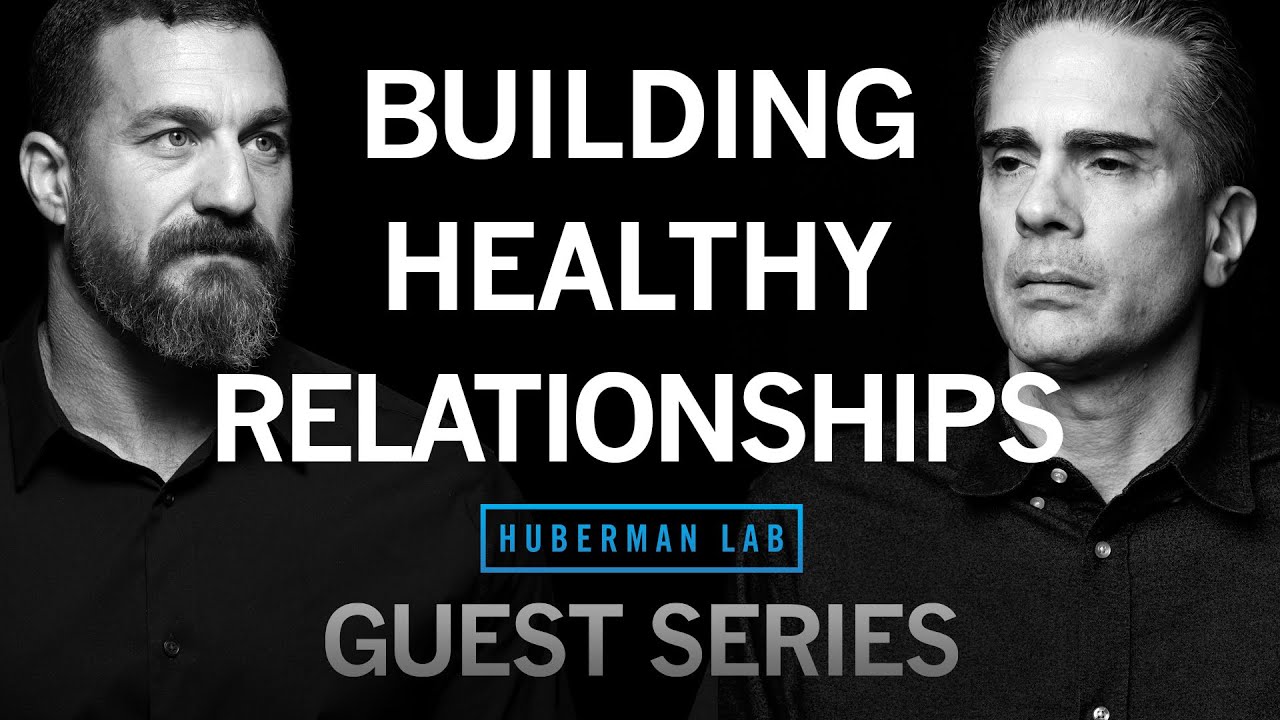
Paul Conti — Psychiatrist and trauma specialist (Stanford- and Harvard-trained) appearing in Huberman's four-part mental health guest series. He frames mental health through 'structure of self' and 'function of self.'
The gist
In the third episode of Huberman's mental health series, Dr. Paul Conti applies his framework of the self to romantic, family, work, and self-relationships. He argues that the usual compatibility metrics (education, shared hobbies, attachment style, love languages) are largely irrelevant, and that what truly matters is a match in 'generative drive' and approaching the world through 'agency and gratitude as verbs.' The conversation works through trauma bonds, mismatched sex drives, narcissism, envy, power dynamics, transactional vs. non-transactional relationships, anxiety, mentalization, and boundaries. A recurring model is that two people form an 'us'—an emergent third entity—and that you must understand yourself before you can accurately understand the other. Conti stresses that even oppressors and victims can change, and that community accountability and support structures matter at every level.
Big reveals
- Conti calls most popular relationship advice 'complete nonsense' and dismisses education, shared hobbies, and love languages as 'utterly irrelevant' to compatibility.
- Reframes the 'trauma bond' as not inherently bad—two people can bond around shared trauma in a way that makes them both healthier.
- Declares there is 'no such thing as a repetition compulsion'—repeated bad relationships are choices that can be changed, not compulsions.
- Claims a small percentage with narcissistic character structure 'does most of the damage on Earth,' driven by envy.
- Conti personally admits he feels attachment insecurity 'about just about everything' due to sudden painful losses in his life.
- Tells the story of a woman trapped in cyclic abuse who only needed a few hundred dollars for a carburetor to escape.
- Insists the reflex in conflict is usually NOT mentalizing—people think they understand the other when they actually don't.
- A friend told Huberman his closest family relationships are 'all kind of transactional'; Conti and Huberman push back hard on that view.
Things worth remembering
- Huberman cites data that dopamine in certain brain areas can rise up to 60% after a Yoga Nidra session.
- Conti says an undergraduate power-dynamics political science course helped him more as a psychiatrist than medical school in that domain.
- Introduces 'the issue of the non-issue'—covert power dynamics where one partner can't raise a grievance for fear of retribution.
- Distinguishes jealousy (benign, motivating) from envy (destructive: bringing the other down feels as good as raising oneself).
- Uses a sex-drive mismatch (a '2' paired with an '8') to show how a generative 'five in the middle' can be better, not a compromise.
- 'Kindergarten'—Conti's one-word summary of good relationship skills: generosity, kindness, letting things go.
- Conti says the happiest people he sees are givers; goodness in the self causes success and happiness, not the reverse.
- 'Anytime you have a closed system without accountability, you're just rolling the dice' for oppression.
- 'Broken compass' metaphor: guiding yourself with a faulty map leads you to others with broken maps, leaving you both wandering.