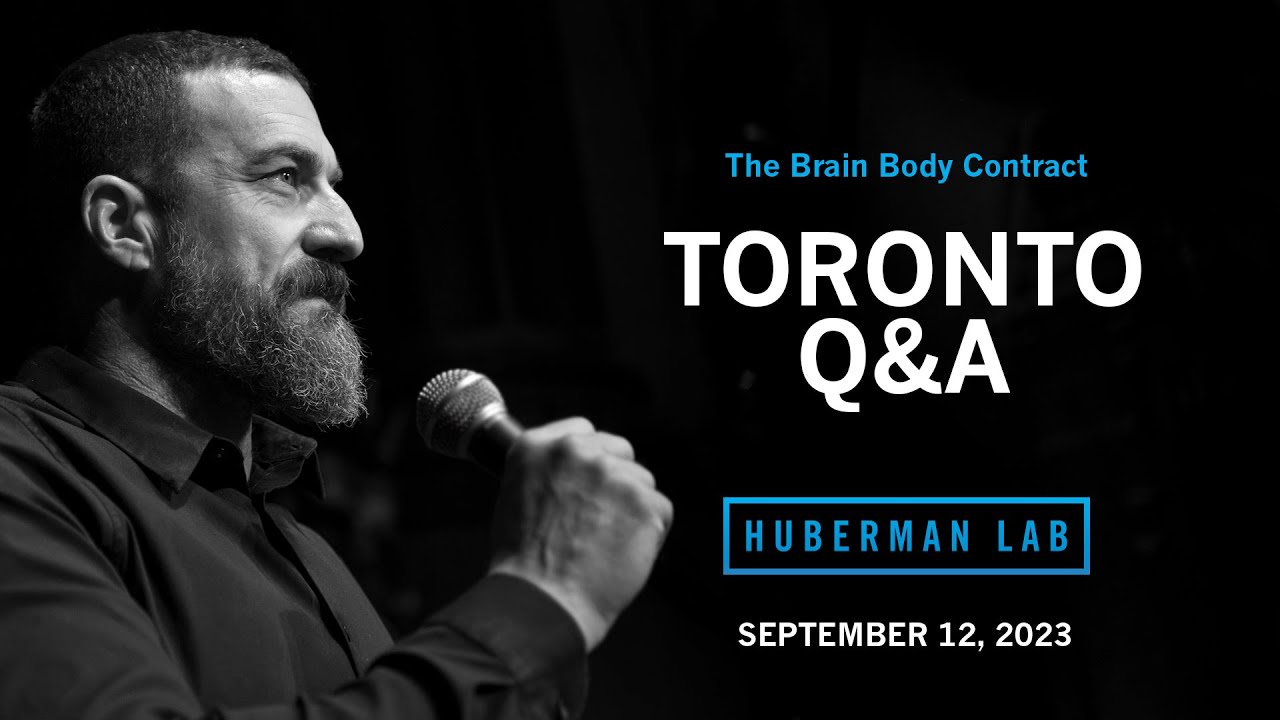
Andrew Huberman — Stanford neuroscientist and ophthalmology professor who hosts the Huberman Lab podcast on science-based tools for everyday life. Here he is both host and subject of a live Q&A in Toronto.
The gist
Recorded after a live lecture, 'The Brain Body Contract,' at the Meridian Theater in Toronto, this Q&A has Huberman fielding audience questions across his core topics. He explains why he did the Paul Conti guest series on mental fitness and the unconscious mind, then covers emotional resilience, fostering inspiration, and combating seasonal depression through morning light exposure. He breaks down how neuromodulators drive neuroplasticity (including a frank take on psychedelics), shares a 'soleus push-up' study for desk-bound people, and closes with his personal 'space-time bridging' perceptual exercise for shifting between time domains.
Big reveals
- Huberman recounts Paul Conti flatly correcting him that the unconscious mind, not the forebrain, is the 'supercomputer' of the mind.
- Admits he was a 'wild kid' who had to do involuntary therapy and hid it for years, fearing people would think he was crazy.
- Says you do NOT need an expensive SAD lamp; a cheap 900-lux drawing tablet for a few minutes each morning offsets seasonal depression.
- Confesses to having taken psychedelics (psilocybin and MDMA, though never together) with a clinician in legal circumstances.
- Bluntly states MDMA 'is meth' (methylenedioxymethamphetamine), just meth with a lot of serotonin added.
- Tells a self-deprecating story of failing at the violin as a kid, quitting after a concert where his fly was down and the neighbor's dog howled.
Things worth remembering
- Descartes called the pineal gland the 'seat of the soul' because there is only one of them in the brain.
- Seasonal depression tracks the melatonin signal getting longer day-over-day, not its absolute duration; the brain runs a slow integrating clock.
- You don't need to watch the sun cross the horizon; what matters for circadian signaling is low solar angle sunlight, not the sunrise itself.
- The soleus is about 1% of total human musculature but can dramatically shift fuel utilization in the body.
- In a University of Houston/Texas study, simply raising the heel ('soleus push-up') produced significant increases in blood glucose utilization and lowered insulin.
- Per Peter Attia's work, people should get 150-200 minutes of zone 2 cardio weekly plus about three days of resistance training.
- Under high stress the brain 'fine slices' time by raising its frame rate, making seconds feel like minutes, like a slow-motion video.
- Huberman credits 'Strummer's Law' (after Joe Strummer): 'No input, no output' as the basis for fostering inspiration.
Recommended in this episode
Books, products and media the guest or host genuinely endorsed here — with the buy link.
Affiliate link — we may earn a commission at no extra cost to you.
The Secret Pulse of Time
Stefan Klein
“if you are interested in more detail, there's a wonderful book called The Secret Pulse of Time. And there's a Hitchcock movie that's discussed in that book.” — Andrew Huberman 00:36:35Find it on Amazon