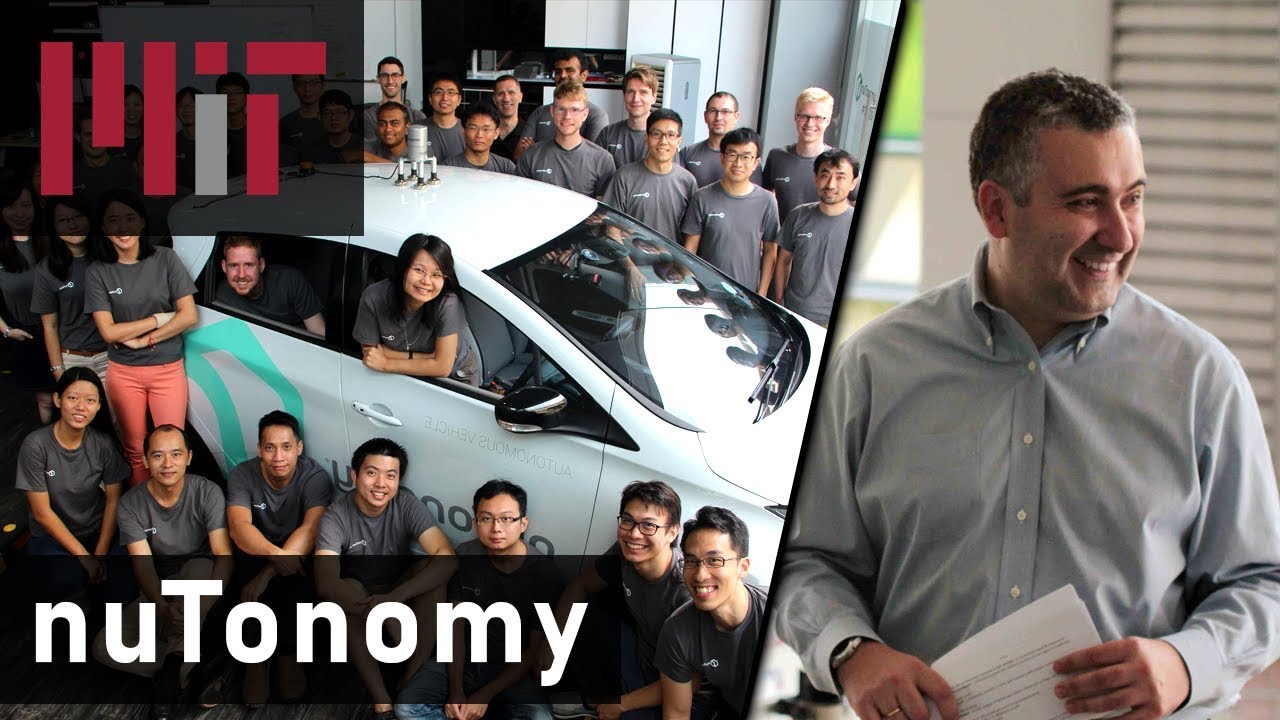
Emilio Frazzoli — CTO and co-founder of nuTonomy, inventor of the RRT* motion-planning algorithm, and former MIT professor who put the first autonomous vehicles on public roads in Singapore.
The gist
In this MIT lecture hosted by Lex Fridman, Emilio Frazzoli lays out his vision for autonomous vehicles, arguing that the biggest payoff is not safety but reclaiming the time people lose driving and enabling genuinely convenient shared mobility. He contrasts the automaker (OEM) path of incrementally adding driver-assist features with nuTonomy's approach of building fully automated cars for geofenced mobility-as-a-service from the start, explaining why level 2 and 3 automation are dangerous and why the product-versus-service distinction changes everything about cost, maps, and maintenance. He dismantles common fears about job loss, noting mobility services are actually manpower-limited worldwide. Technically, he argues the core challenge is decision-making (driving policy): rather than coding or learning every rule, nuTonomy generates many candidate trajectories and checks them against formally specified, hierarchically ordered rules. He closes by claiming the deepest unsolved problem is that humans have never rigorously defined how vehicles should behave in the first place.
Big reveals
- Frazzoli only joined the Singapore future-mobility project because he wanted to visit Singapore, and invented the ride-hailing pitch on the spot in a five-minute phone call before Uber was widely known.
- His back-of-envelope math finds the value to society of reclaiming driving time (~$1.2 trillion/year) exceeds the value of increased safety.
- He calls the numbered SAE automation levels an 'enormously bad idea' because levels 2 and 3, which require humans to supervise automation, go against human nature.
- He argues only level 4 or 5 automation captures the technology's value; the true game-changing feature is cars moving with nobody inside.
- If everyone in the world used Uber for mobility, one in seven people would have to drive for Uber, which he says proves driverless fleets are about supply of mobility, not job loss.
- He claims good driving behavior is not just hard to code but also hard to learn, while checking whether a candidate trajectory is good is easy (an NP-hardness style argument).
- His final thesis: the biggest challenge in autonomous vehicles is that we have never precisely defined how we want any vehicle, including human-driven ones, to behave.
Things worth remembering
- The 'cost of a statistical life' used by the US government is about nine million dollars.
- US road accidents are estimated to cost about $300 billion a year economically plus ~$600 billion in pain and suffering, nearing $1 trillion total.
- A working autonomous car-sharing system is estimated to be worth ~$2,000 per person per year, assuming a sharing factor where one shared vehicle replaces four privately owned ones.
- The Uber fleet reportedly drives through about 95 percent of Manhattan every two hours, illustrating how fleets can continuously generate map data.
- Truck drivers account for 25 percent of all job-related deaths in the US, making it the single most dangerous industry.
- In the late 1990s in Germany, Ernst Dickmanns drove hundreds of miles on highways using only cameras and basic computer vision, no GPUs or deep learning.
- nuTonomy's cars in Singapore drive in real public traffic, handling parked trucks, motorcycles, pedestrians, and right turns across traffic with no human intervention.
- An early version of nuTonomy's traffic-light code learned to speed up at yellow lights, an example of a learning system acquiring the wrong behavior.
- nuTonomy handles infeasible situations using a lexicographic hierarchy of rules, modeled conceptually on Asimov's Three Laws of Robotics.
- Frazzoli notes there is no mathematical definition of 'right of way' anywhere in the rules of the road, despite it underpinning many traffic laws.