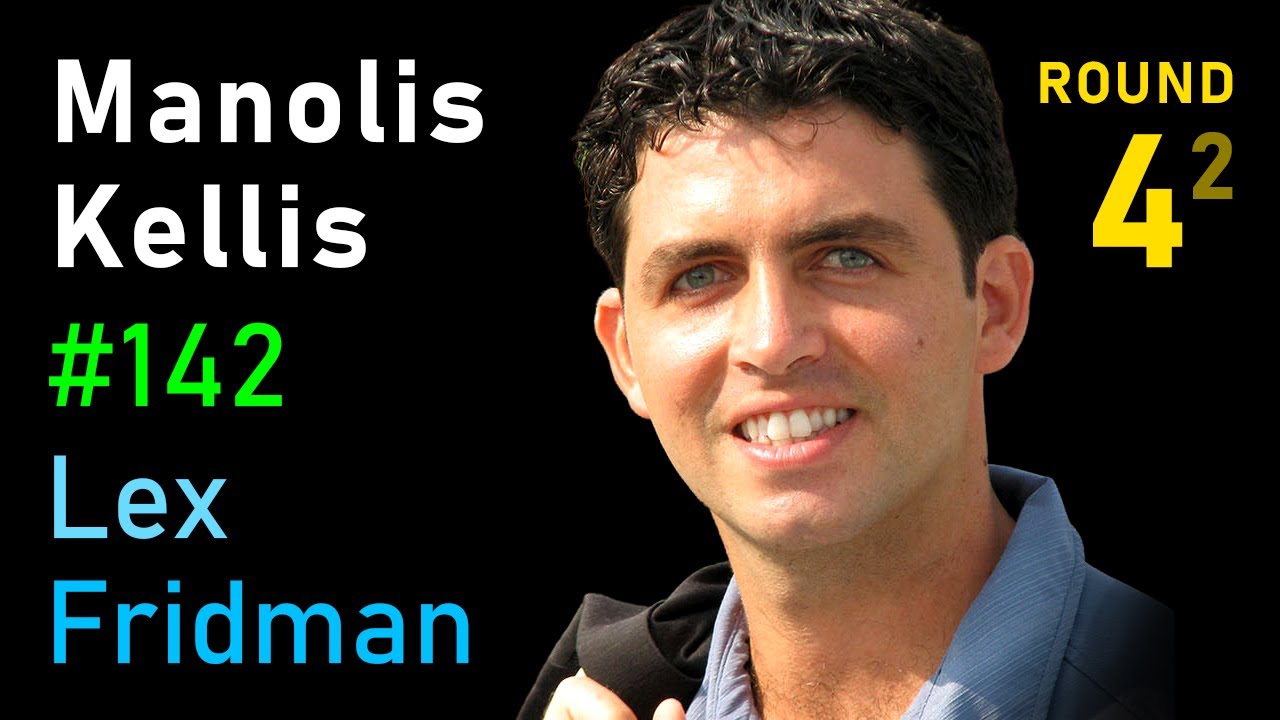
Manolis Kellis — MIT professor and head of the MIT Computational Biology Group, a leading genomics researcher. This is his fourth appearance on the Lex Fridman Podcast.
The gist
In this philosophical conversation tied to episode number 142 (a nod to the number 42 from The Hitchhiker's Guide to the Galaxy), Manolis Kellis and Lex Fridman explore the meaning of life. The first 40 minutes wander through the songs that shaped Kellis across Greece, France, and New York, drawing life lessons from Greek folk songs, Gainsbourg, Sting, Pink Floyd, and Alison Krauss. They then turn to human cognitive evolution, arguing language came after music, and that humanity is uniquely able to perceive reality across many layers from quantum to cosmic. The discussion ranges over AI and emergent behavior, the co-evolution of genes and memes, Neuralink's limits, and legacy. Kellis closes by reciting two of his own poems.
Big reveals
- Kellis argues language comes after music and song, with sequential dance movements a prelude to the cognitive capabilities that enabled language.
- He lays out an elaborate catalog of why 42 is special (rainbow angle, panda chromosomes, Egyptian Maat's 42 questions) then admits it's basically a random number.
- He claims the search for meaning is itself the meaning of life: 'when you found it you're dead.'
- Kellis says life is inevitable on every planet, but the evolution to self-awareness and cognition may not be inevitable.
- He suggests general intelligence may not need a new architecture, just 'a ton more hardware,' and humans aren't that different from great apes.
- He is deeply skeptical of Neuralink, arguing memories are encoded so uniquely per person that direct brain-to-brain transfer would be incompatible.
- He proposes that conversation may be the most efficient way to transfer knowledge between neural systems, superior to copying parameters.
Things worth remembering
- Brain regions symmetric to language areas let people who lost speech after injury still sing.
- The human brain consumes roughly 15-20 percent of the body's energy, a commitment no other species makes.
- The human skull can only grow so much before the pelvic opening would kill the mother at birth, so the brain folded for more capacity instead.
- Dinosaurs ruled Earth for 135 million years; humans have been around about one million.
- Hardware improvements pass through vertical (genetic) inheritance while software (culture, ideas) passes horizontally.
- Kellis cites the asteroid Apophis as a threat around 2068, framing 48 years as plenty of time given technological progress.
- He extends Dawkins's meme concept: ideas reshape where cognitive systems (humans) physically cluster, so genes and memes co-evolve.
- Kellis has posted all his MIT lecture recordings freely online since 2001, training generations of computational biologists.
- He says he writes poems in one pass without a rhyming dictionary, calling the rhyme an emergent phenomenon.
Recommended in this episode
Books, products and media the guest or host genuinely endorsed here — with the buy link.
Affiliate link — we may earn a commission at no extra cost to you.
Careless Whisper
George Michael
“no no that it's an amazing song for me i had recorded a small part of it as it played at the tail end of the radio” — guest 00:12:53Find it on Amazon
Englishman in New York
Sting
“so i moved to new york so stings englishman in new york yeah magnificent song” — guest 00:17:00Find it on Amazon
The Wall
Pink Floyd
“the whole album of pink floyd and the movie just marked me enormously yeah as a as a teenager just the wall” — guest 00:20:08Find it on Amazon
Russians
Sting
“again going back to sting now it's the political songs russians and i think that song should be a a new national anthem for the u.s” — guest 00:25:20Find it on Amazon
The Lucky One
Alison Krauss and Union Station
“alison krause and union station country song believe it or not the lucky one so i i've never identified as much with the uh lyrics of a song as this one” — guest 00:33:37Find it on Amazon
Contact
Carl Sagan
“the movie contact and the book is just so beautiful this whole concept of we don't need to travel physically we can travel as light” — guest 00:58:31Find it on Amazon