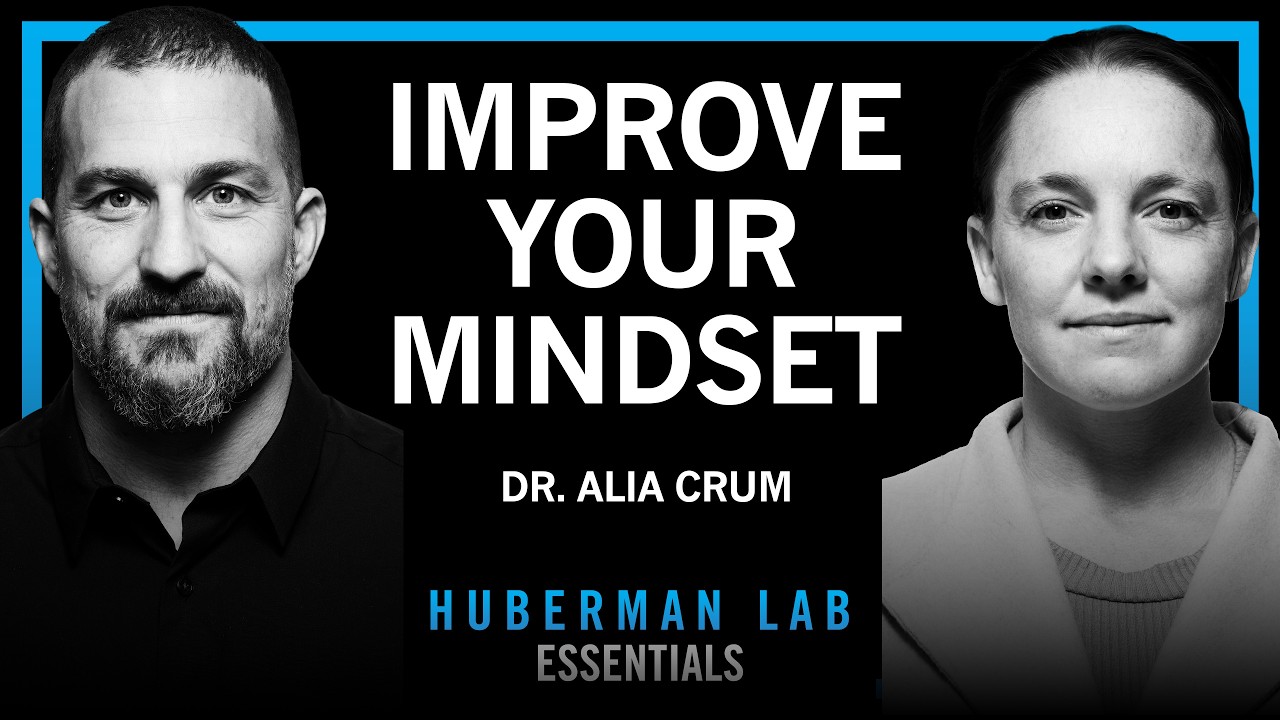
Dr. Alia Crum — Stanford psychology professor and director of the Mind & Body Lab, known for pioneering research on how beliefs and mindsets influence physiological health outcomes.
The gist
Andrew Huberman revisits his conversation with Dr. Alia Crum on the science of mindsets, defined as core beliefs about a domain that orient our expectations, explanations, and goals. Crum walks through her landmark milkshake study showing that beliefs about a food's calories alter the gut hormone ghrelin response, and her hotel housekeeper study where simply reframing work as exercise produced real weight and blood pressure improvements. The bulk of the conversation focuses on stress, arguing that a 'stress-is-enhancing' mindset can improve health, performance, and well-being without denying stress is hard. She presents a three-step approach to reframing stress and frames mindsets as a portal between conscious and subconscious physiology.
Big reveals
- In her milkshake study, identical 300-calorie shakes were labeled either indulgent (620 cal) or sensible diet shakes.
- Believing they drank the indulgent shake dropped participants' ghrelin three times more than believing it was the diet shake.
- Counterintuitively, the 'indulgent' eating mindset, not the 'healthy' one, produced the more satiating, adaptive physiological response.
- A third of hotel housekeepers said they got zero exercise despite being on their feet all day pushing carts.
- After being told their work counted as exercise, housekeepers lost weight and dropped systolic blood pressure ~10 points with no behavior change.
- UBS employees who watched 9 minutes of 'stress-enhancing' videos had fewer physical symptoms and reported better work performance.
- People inspired toward enhancing stress mindsets showed more moderate cortisol and higher DHEA responses.
Things worth remembering
- We have more data on the placebo effect than any drug, because new medications must outperform placebo in trials.
- A Science paper documented psychogenic fever: believing you're sick can raise body temperature 1-3 degrees.
- The 'nocebo effect' is the placebo's flip side: negative beliefs producing real negative consequences, like warned-about side effects.
- Physiological 'toughening' means stress-released catabolic hormones can recruit anabolic hormones that build muscle and neurons.
- Duncan French's UFC research found a stressful first-time skydive raised testosterone, contradicting standard stress-hormone assumptions.
- Adrenaline (epinephrine) is biochemically derived from dopamine, linking the stress response to growth-related signaling.
- Stress is defined as a neutral response to anticipated or actual adversity in your goal-related efforts, we only stress about what we care about.
- Crum's three-step reframe: acknowledge the stress, welcome it, then utilize the stress response to achieve what you care about.