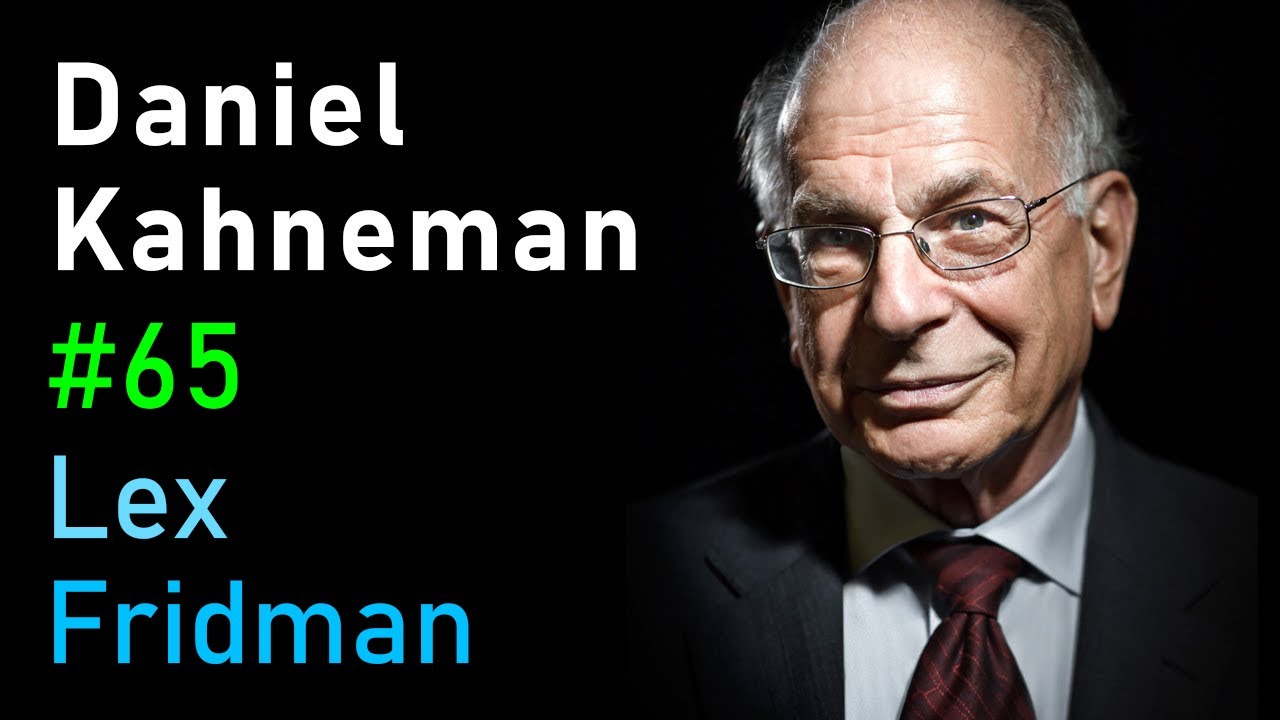
Daniel Kahneman — Nobel Prize-winning psychologist and economist, author of 'Thinking, Fast and Slow,' known for pioneering work on cognitive biases, prospect theory, and judgment with longtime collaborator Amos Tversky.
The gist
Lex Fridman interviews Daniel Kahneman about his foundational work on human cognition, beginning with reflections on World War II, the Holocaust, and the psychology of in-groups versus out-groups. Kahneman explains his distinction between fast, intuitive System 1 thinking and slow, deliberate System 2 thinking, then maps these ideas onto modern AI, arguing deep learning resembles System 1 but lacks reasoning, causality, and grounding. The conversation turns to his theory of the experiencing self versus the remembering self and the paradoxes it creates for happiness and decision-making. Kahneman also discusses the replication crisis in psychology, the difficulty of between-subject experiments, the power of collaboration, and why people rarely change their minds. He closes by reflecting on tests for intelligence and the unknowable meaning of life.
Big reveals
- Kahneman says the only big surprise of WWII for him was that the German genocide could happen at all, and that the Eichmann trial showed 'if it could happen in Germany it could happen anywhere.'
- He frames modern deep learning as essentially a 'System 1 product' that matches patterns but cannot reason, represent causality, or represent meaning.
- Kahneman suggests explainable AI may not need to reflect truth, it just needs to 'tell a convincing story' that people will accept.
- He admits he abandoned happiness research because he could not solve the conflict between what makes the experiencing self versus the remembering self happy.
- He says he does not connect with Viktor Frankl's philosophy and believes he himself would have given up and died in a concentration camp.
- He reveals 53 behavioral-change studies by the best researchers, aiming to increase gym attendance, all had a success rate of zero.
- Kahneman states that even scientists almost never change their minds once committed, and a 30-year controversy with a critic will never be resolved.
Things worth remembering
- System 2 is illustrated by 27 times 14, requiring effortful algorithmic steps, while System 1 effortlessly answers 2 plus 2.
- A strong chess player's good moves arise unconsciously through System 1; System 2 merely verifies them.
- Children learn from two or three examples while machines need a million, a fundamental unsolved difference in learning.
- Crossing a street is a 'dance' where a pedestrian looks the driver in the eye, then looks away to signal commitment, like a game of chicken.
- Kahneman distinguishes the self that lives from the self that evaluates, noting decisions are governed by memories, not actual experiences.
- We take vacations largely to construct memories rather than to have experiences, evidenced by the amnesia-drug thought experiment.
- He observes life might be better if people stopped scoring themselves with the 'how am I doing' question.
- Researchers have poor intuition about between-subject experiments because they themselves mentally occupy a within-subject perspective.
- The 'focusing illusion': when you think about something, it looks far more important than it really is.
- Public opinion shifts not from evidence but from trusted leaders, so a religious leader endorsing climate action would have huge effect.
Recommended in this episode
Books, products and media the guest or host genuinely endorsed here — with the buy link.
Affiliate link — we may earn a commission at no extra cost to you.
Thinking, Fast and Slow
Daniel Kahneman
“in your book thinking fast and slow you describe two modes of thought. system one, the fast, instinctive and emotional one” — Lex Fridman 00:08:27Find it on Amazon