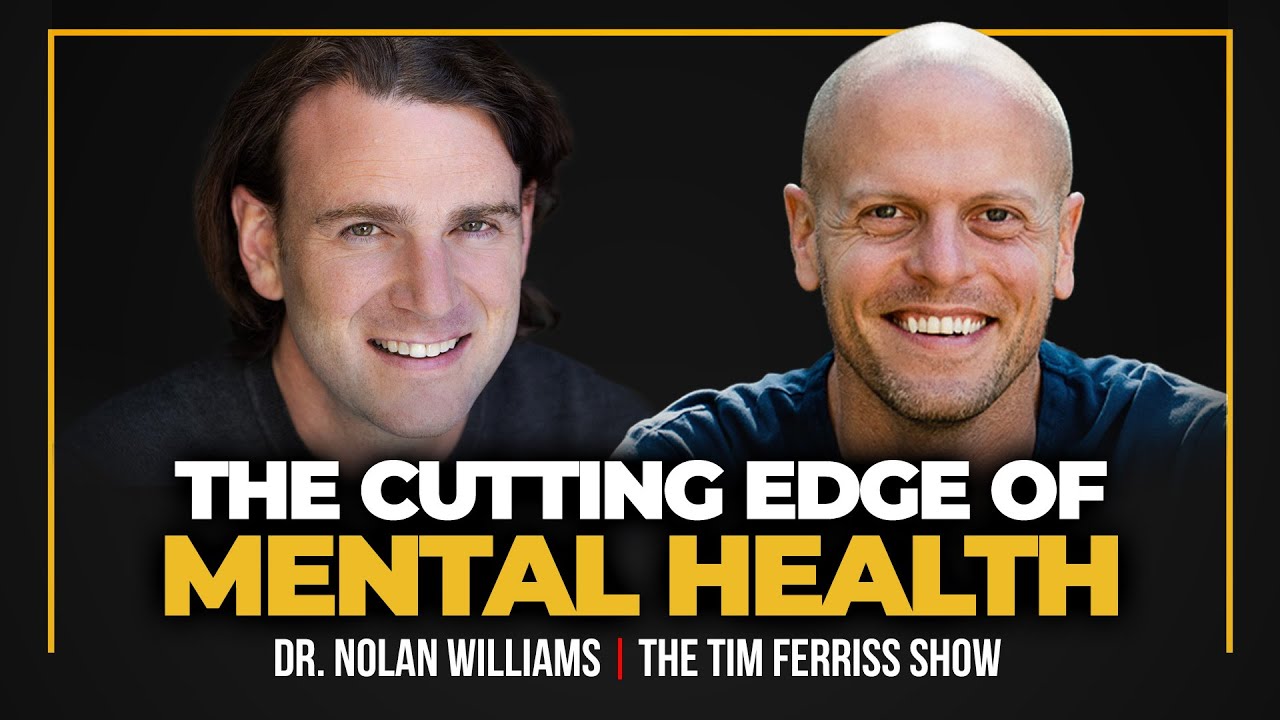
Dr. Nolan Williams — Psychiatrist and neuroscientist directing the Stanford Brain Stimulation Lab; developer of SAINT (Stanford Accelerated Intelligent Neuromodulation Therapy) and lead investigator on the Stanford ibogaine trial for veterans.
The gist
Tim Ferriss interviews Dr. Nolan Williams about a third 'circuit-based' era of psychiatry that treats mood disorders by rewiring brain networks rather than chasing chemical imbalances. Williams details SAINT/accelerated TMS, which compresses a six-week course of stimulation into about five days and produced remission in patients who had been depressed for years and failed multiple medications. He walks through the neuroscience of resting-state functional connectivity, a depression biomarker in which the cingulate fires before the dorsolateral prefrontal cortex, and how this predicts treatment response. The conversation then turns to his Stanford ibogaine study in special-operations veterans with traumatic brain injury, soon to be published in Nature Medicine, including how he mitigated ibogaine's cardiac (torsades) risk with IV magnesium. Throughout, Ferriss shares his own experience undergoing two weeks of accelerated TMS and the two men speculate about the future of focal neuromodulation, focused ultrasound, and performance enhancement.
Big reveals
- Williams describes treating Deirdre Lehman, one of the most severe patients they had ever seen (catatonic, suicidal bipolar depression), and having her go from that state to completely normal in roughly 24 hours with accelerated TMS.
- A paper in PNAS identified a depression biomarker: in healthy people the dorsolateral prefrontal cortex fires slightly before the cingulate, but in about 70 percent of depressed patients this signal is flipped, and only patients with the flipped biomarker responded to SAINT.
- SAINT compresses a full six-week (about 30-session) FDA-cleared TMS course into a single day by giving 10 triple-dose sessions of 1,800 pulses, delivering roughly seven and a half months of TMS in five days, with average remission at 2.6 days.
- In treatment-resistant patients where conventional TMS yields about 16 percent remission, SAINT achieved 90 percent remission in the open-label pilot and 79 percent transiting through remission in the randomized controlled trial (13 percent for sham).
- Williams' Stanford ibogaine trial in 30 veterans with traumatic brain injury produced results so striking he ordered the postdocs to delete the code and redo the analysis, suspecting an error; the second run reproduced the same dramatic improvements, now holding out to a year.
- To address ibogaine's roughly one-in-300 risk of fatal Torsade de pointes arrhythmia, every patient received IV magnesium upfront; about a thousand operators have gone to Mexico with this protocol and no torsades cases, versus a death in a 10-person New Zealand study.
- An anecdotal deep-brain-stimulation case: a man treated for OCD became obsessed with Johnny Cash and sold all his other albums, reverted to old tastes when his battery died, and regained the obsession after a battery replacement, illustrating how little is understood about content-level brain effects.
Things worth remembering
- Williams frames psychiatry in three eras: 1.0 (Freud/content), 2.0 (the serendipitous chemical era beginning with Thorazine), and 3.0 (the current circuit/neuromodulation era).
- TMS (transcranial magnetic stimulation) was originally developed by Tony Barker in the UK as a motor probe based on Faraday's law, inducing current in electrically conducting brain tissue while bypassing skin, scalp, and skull.
- SAINT uses 90 percent of resting motor threshold, depth-corrected for prefrontal atrophy in older patients; there has never been a TMS-related seizure at sub-motor-threshold intensity, so risk tracks intensity rather than pulse count.
- TMS produces an anti-pain (antinociceptive) effect by releasing endogenous opioids, which can be blocked with opioid-blocking drugs as shown in studies by Joe Taylor.
- RCT patients averaged about nine years in their current depressive episode, five (plus or minus two) medication failures, and a lifetime depression load of roughly 25 years.
- On average it takes about seven years to diagnose bipolar disorder from a patient's first depressive episode.
- Comparative remission benchmarks cited: electroconvulsive therapy about 48 percent, a single ketamine infusion about 30 percent, with later-stage pharmaceutical interventions under 10 percent.
- Williams first learned about ibogaine after randomly picking up Daniel Pinchbeck's 'Breaking Open the Head' while stranded in the San Salvador airport on the way to kite surf in Peru.
- Ibogaine is described as a 'neurogen' acting across many receptor systems (kappa, mu, NMDA, SERT, some 5-HT2A) and upregulating BDNF and GDNF, unlike classic psychedelics that work mainly through 5-HT2A.
- Williams and Raag Airan are packaging ketamine into nanoparticles delivered by IV and opened with focused ultrasound to drop the drug only into the cingulate, aiming to test 'tripless' therapeutic effects by targeting specific brain regions.
Recommended in this episode
Books, products and media the guest or host genuinely endorsed here — with the buy link.
Affiliate link — we may earn a commission at no extra cost to you.
I Feel Love
Rachel Nuwer
“She also has a great book on MDMA and MDMA-assisted psychotherapy, the history and implications that recently came out” — Tim Ferriss 01:58:34Find it on Amazon
National Geographic (article on ibogaine/iboga by Rachel Nuwer)
National Geographic
“there's a great piece that came out in National Geographic not too long ago by journalist named Rachel Nuwer” — Tim Ferriss 01:58:34Find it on Amazon