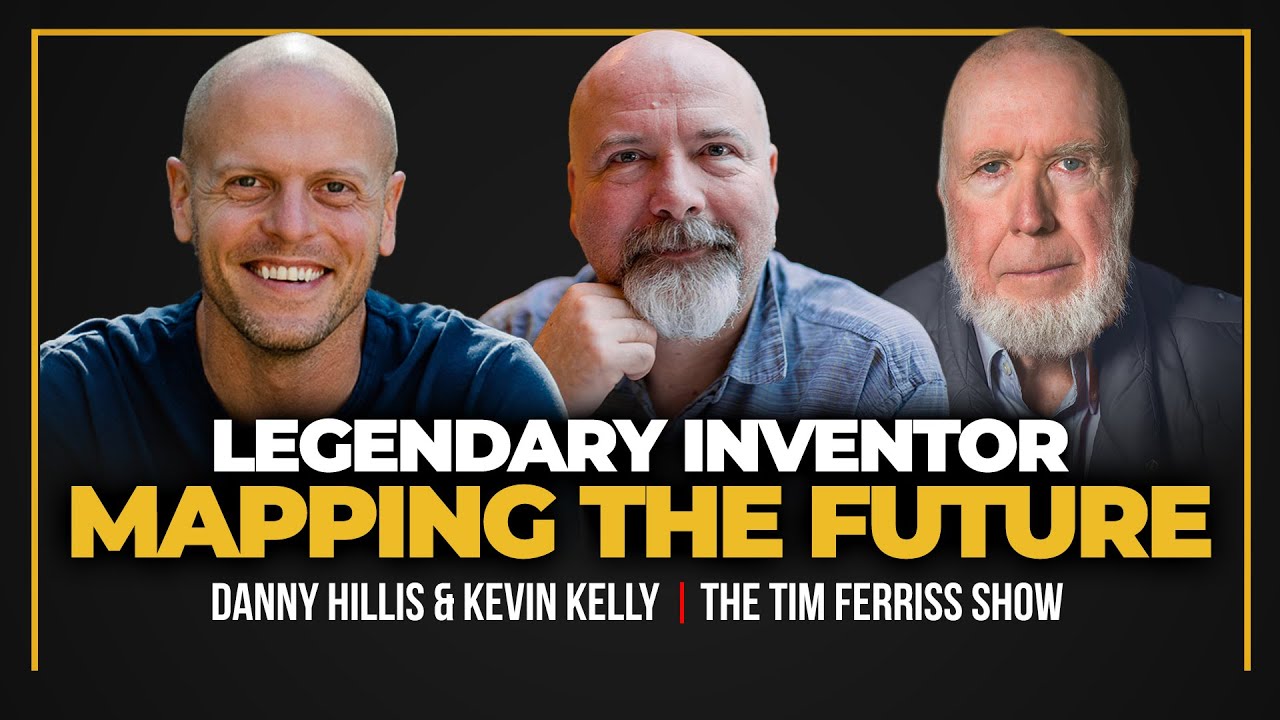
Danny Hillis and Kevin Kelly — Danny Hillis is an inventor, computer scientist, and co-founder of Thinking Machines and Applied Invention who built the first massively parallel computers and designed the 10,000-year clock; Kevin Kelly is founding executive editor of Wired, author of 'Out of Control,' and a longtime collaborator on the Long Now Foundation.
The gist
Tim Ferriss talks with Danny Hillis and Kevin Kelly about the craft of invention, how Hillis chooses what to work on, and the lessons he learned across computing, Disney, biotechnology, and agriculture. Hillis explains his method of learning by hanging out with smarter people, recounting how he talked his way into MIT's AI lab under Marvin Minsky and recruited Nobel laureate Richard Feynman to Thinking Machines. The conversation turns to AI, which Hillis frames not as artificial intelligence but as human intelligence running on an artificial substrate, currently stuck in an imitation stage. They explore the growing entanglement of nature and technology, the future of cybersecurity via zero-trust packet routing, proteomics for catching disease before symptoms, and Hillis's heretical view that cause and effect is just a story we tell. The episode closes on the 10,000-year clock, optimism about the long arc of history, and what Hillis tries to optimize: impact that matters long after he is dead.
Big reveals
- Hillis started a company as an MIT graduate student to build a parallel computer; when MIT forbade it, he did it anyway and hired faculty, including the ex-university-president Jerry Wiesner, until they stopped bothering him.
- Thinking Machines built the fastest computers in the world for years but never became a great business; a chip supplier took similar chips, made them for video games, and 30 years later achieved what Hillis set out to do, that company was Nvidia.
- Hillis argues what we call AI today is not artificial intelligence but human intelligence living on an artificial substrate, currently in an imitation stage that is just beginning to peek beyond into reasoning.
- Hillis and a group of early-internet builders invented 'zero trust packet routing,' where every packet carries a passport and visa proving permission, and Oracle has announced its cloud will start using the protocol.
- Working with oncologist David Agus, Hillis reframed cancer as a verb, something your body does and usually stops, and proposed reading out proteins dynamically as a 'debugger' to catch disease before symptoms appear.
- Hillis built an early pinch-to-zoom touch table that went into the Obama White House Situation Room, and his prior patent later invalidated Apple's pinch-to-zoom patent so Android and Samsung users could keep the gesture.
- Hillis's stated heresy: he does not believe in cause and effect, arguing it is just a story our social brains tell, and that digital computers are 'the ultimate fantasy' of chaining causes and effects together.
- Hillis frames 'the entanglement': things once natural (atmosphere, genes, minds) are now technological artifacts, while things once engineered (the internet, ChatGPT) have become evolved and not fully understandable.
Things worth remembering
- Applied Invention's recruiting test was a box of weird objects (a space shuttle tile, synthetic diamond, a Mogen circumcision clamp); curiosity and engagement with the objects, not knowledge, signaled a good hire.
- Robin Williams once went through the box and identified every item, riffing elaborately on it as 'space alien sex toys.'
- Hillis's title at Disney was 'Disney Fellow,' a title previously held only by Salvador Dali; they also made him a vice president of Imagineering.
- Applied Invention's three project criteria: a senior partner must be excited, it must make financial sense, and it must pass the 'non-redundancy criterion', it would not happen anyway without them.
- Hillis got into Minsky's lab by reading DARPA proposals in the lobby library, inventing a picture-based way for non-reading kids to program (related to LOGO), then fixing errors on Minsky's basement computer diagrams until Minsky assumed he worked there.
- Richard Feynman showed up to Thinking Machines, saluted, said 'Richard Feynman reporting for duty,' and his first job was Quartermaster buying supplies; he later started the company's first quantum computing project.
- Hillis invented 'Babble,' a device that masked office conversations by talking over you in a synthesized version of your own voice; Herman Miller bought it, but the company died after its CEO had a heart attack.
- Hillis's answer for instantly cooling food (the reverse of a microwave) is laser cooling, done atom by atom, which he jokes would take a while on a half chicken.
- Hillis predicts that in 100 years we will realize quantum computers do not 'want' to do computation, and their truly useful application will be something other than computing.
- The 10,000-year clock physically exists inside a mountain in West Texas, hanging in a vertical tunnel with a spiral staircase carved into the rock, almost 500 feet deep.
Recommended in this episode
Books, products and media the guest or host genuinely endorsed here — with the buy link.
Affiliate link — we may earn a commission at no extra cost to you.
Out of Control
Kevin Kelly
“I want to put in a plug for my very first book out of control which was about that entanglement” — Kevin Kelly 01:24:21Find it on Amazon
Patterns in the Stone
Danny Hillis
“sometime in the 90s I wrote a little book about how computers work patterns in the stone... a high school student that was interested in computers could understand it” — Danny Hillis 02:14:31Find it on Amazon