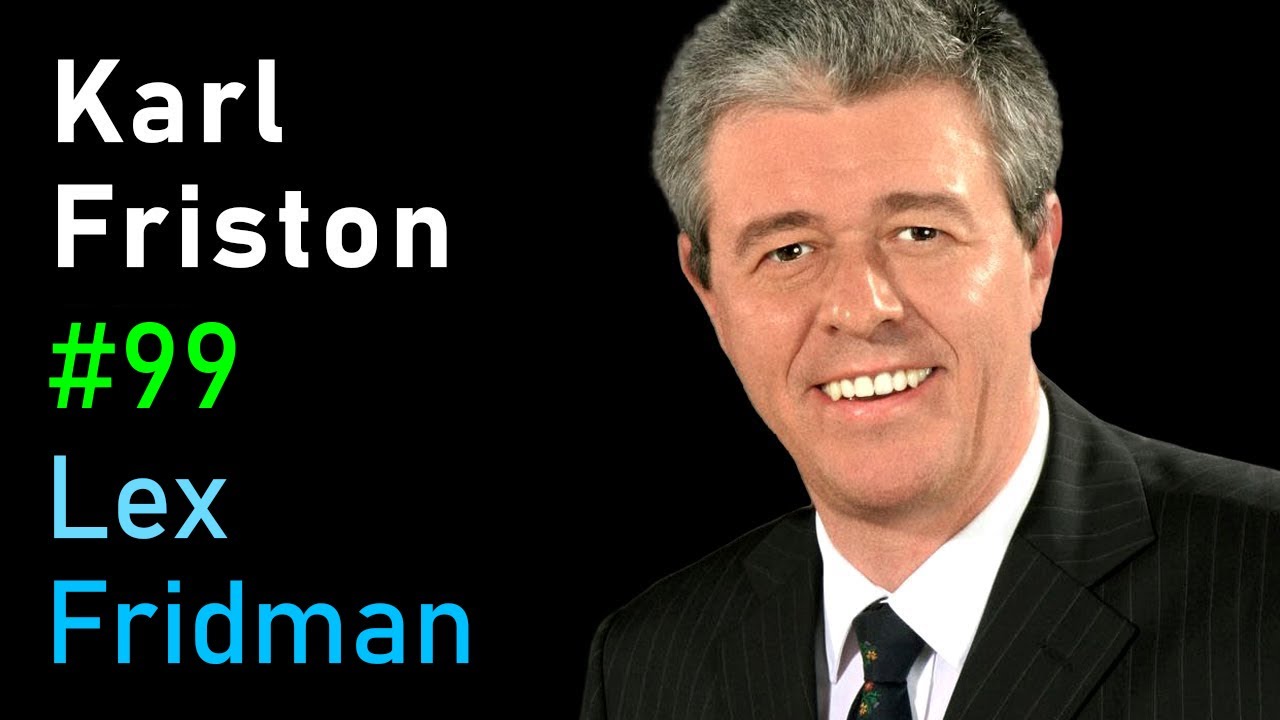
Karl Friston — One of the most-cited neuroscientists in history, known for foundational work in brain imaging (statistical parametric mapping) and for originating the free energy principle of action and perception.
The gist
Lex Fridman talks with neuroscientist Karl Friston about how much of the brain we actually understand, from microcircuitry up to whole-brain function. They explore the brain's hierarchical, sparse, recurrent structure, the trade-offs of neuroimaging methods, and the promise and limits of brain-computer interfaces. The bulk of the conversation develops Friston's free energy principle: a formal account of why anything that exists must appear to minimize variational free energy. From there they build toward living systems, agency, planning, consciousness, self-awareness, and finally the meaning of life as fulfilling the narrative beliefs about what kind of creature you are.
Big reveals
- Friston argues there are principled reasons NOT to map every neuron, comparing it to studying thermodynamics by examining individual gas molecules.
- He compares controlling the brain via BCI to controlling the weather, suggesting aspirational sci-fi BCIs may never truly work.
- He reframes the question from 'what is alive' to 'what does it mean to exist,' calling it existential rather than living.
- Friston introduces the Markov blanket as the mathematical surface separating a thing's internal and external states.
- He claims the only way you can ever change the universe is by moving, and doing so non-randomly is what makes you alive.
- He ties consciousness to the capacity to plan and countenance the future, drawing lines between a virus, an ant, and a self-aware being.
- Friston argues self-awareness emerges only because you live in a social world of others like you and must infer it's 'me, not you.'
Things worth remembering
- Roughly only eight percent of all currency in the world is physical money; the other 92 percent exists only digitally.
- The farther apart two parts of the brain are, the less likely they are to be directly wired together.
- The brain's heavy computation happens on the gray-matter surface, while the interior is fatty white-matter wiring.
- Brain metabolism must be driven in the moment; active brain regions need blood within a couple of seconds.
- 'Blobology' is a real fond term for the study of activation blobs on brain maps, and the math behind it uses Euler characteristics.
- Variational free energy is mathematically the same as the negative evidence lower bound (ELBO) used in machine learning.
- Friston argues machine learning sidesteps the movement problem by assuming it can see all the data via big data.
- The philosophical concept of vagueness (when does a pile of sand become a pile) complicates drawing a line for consciousness.
- Friston's closing words: your arm moves because you predict it will, and your motor system seeks to minimize prediction error.