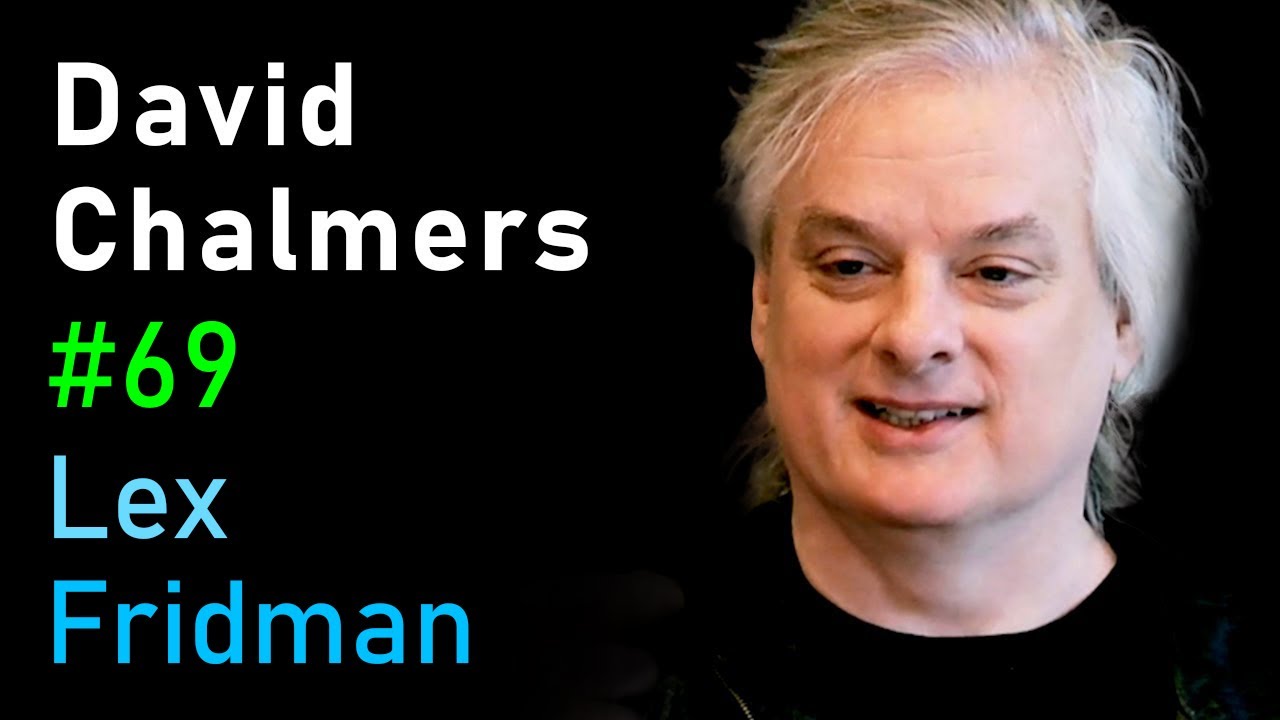
David Chalmers — Philosopher and cognitive scientist at NYU specializing in philosophy of mind and consciousness, best known for formulating the 'hard problem of consciousness.'
The gist
Lex Fridman talks with philosopher David Chalmers about the deepest puzzles of the mind. They open with simulation theory, where Chalmers argues that even if we live in a simulation, our reality is still real. The bulk of the conversation centers on the hard problem of consciousness, why subjective experience exists at all, and Chalmers' openness to panpsychism, the view that consciousness is a fundamental feature of reality. They also discuss AI consciousness, zombies, moral status of machines, free will, cloning, and illusionism. Chalmers closes by saying he would choose immortality and hopes for an infinitely rich, unpredictable future.
Big reveals
- Chalmers argues that even if we are in a simulation, the world is still fully real, just a different version he calls 'reality 2.0.'
- He claims humans are 'somewhere very near the bottom' of the scale of possible intelligent beings.
- Chalmers reveals he had childhood synesthesia where songs had colors, which faded away around age 20.
- He lays out cosmopsychism: a Newtonian universe as countless tiny conscious subjects, or the whole quantum wave function as one cosmic mind.
- He argues consciousness is the source of all meaning and value in the universe; without it, nothing would be better or worse.
- Chalmers admits illusionism (that consciousness itself is an illusion) is attractive and powerful but he finds it ultimately implausible.
- He raises the 'zombie apocalypse': superintelligent AI taking over with no consciousness, which he calls a moral disaster.
- Chalmers says he would absolutely choose to upload his mind and become immortal.
Things worth remembering
- If we are at simulation 'level 42,' the top level zero must be enormous, likely infinite with a very high cardinality.
- Chalmers' working hypothesis is that consciousness comes from patterns of information processing (software), not specific biology (hardware).
- He frames newborn babies as a case where we literally watch consciousness get engineered into existence.
- Anesthetics were once withheld from newborns being circumcised because some believed babies couldn't feel pain.
- Christof Koch's integrated information theory leads to a panpsychist view where even a couple of particles have some consciousness.
- Chalmers poses a 'zombie trolley problem': kill one conscious being or five non-conscious humanoid robots.
- He argues that a system being genuinely puzzled about its own consciousness is good evidence that it is conscious.
- Chalmers predicts a civil rights movement for robots once they ask us not to hurt them.
- He wrote about the 'meta-problem': explaining why we are puzzled by the hard problem in the first place.
- His optimistic vision of immortality is climbing the set-theoretic hierarchy, an infinitely creative and unpredictable future.