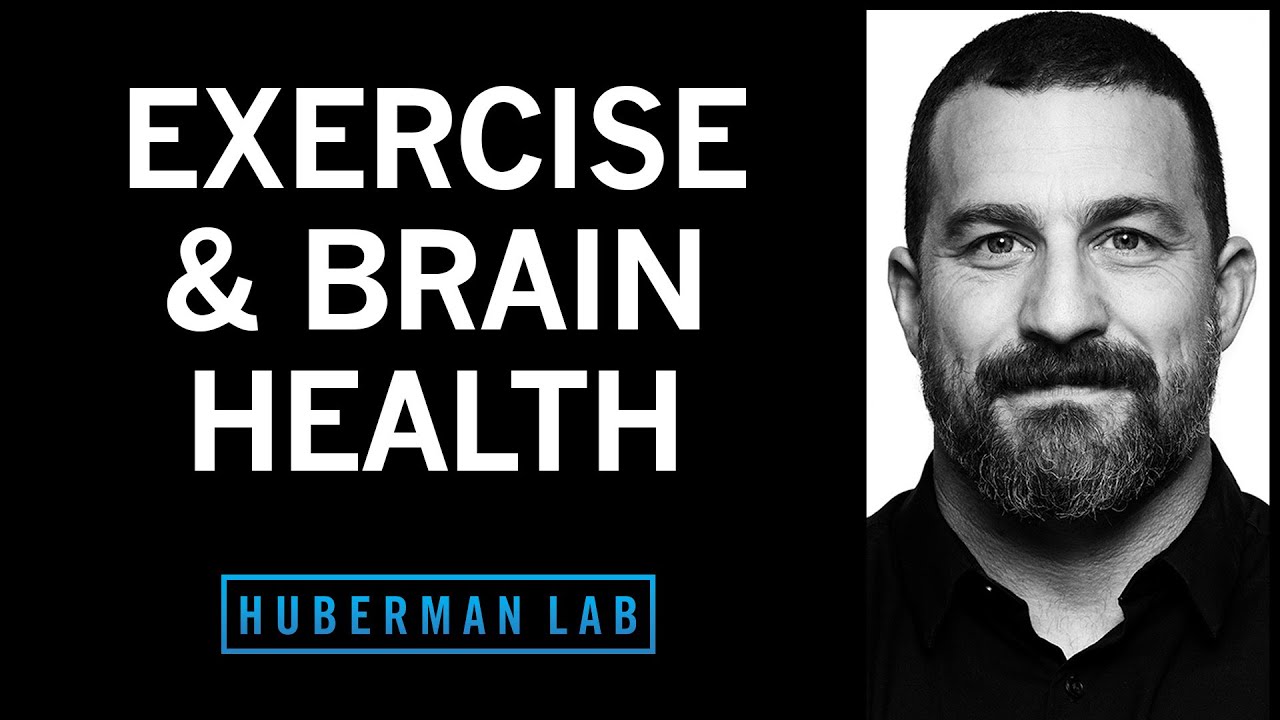
Andrew Huberman (solo) — Stanford professor of neurobiology and ophthalmology and host of the Huberman Lab podcast, who translates peer-reviewed neuroscience into actionable health protocols.
The gist
A solo episode synthesizing tens of thousands of studies on how exercise improves brain health, longevity, and performance. Huberman explains that ~60-70% of the acute brain benefits of exercise come from autonomic arousal (adrenaline/norepinephrine), then details the body-to-brain pathways involved, including the vagus nerve, locus coeruleus, the recently discovered motor-cortex-to-adrenal circuit, osteocalcin from loaded bones, lactate, and BDNF. He lays out a practical weekly framework: long slow distance cardio, high-intensity interval training, time-under-tension resistance work, explosive/eccentric jumping, and a fifth category, doing exercise you hate to grow the anterior mid-cingulate cortex linked to super-aging.
Big reveals
- Just six 6-second all-out sprints with one-minute rests significantly boost cognitive performance acutely.
- Huberman estimates 60-70% of exercise's acute brain benefits are explained by arousal, not other molecules.
- Two high-intensity interval sessions in one day can actually diminish cognitive performance afterward via reduced cerebral blood flow.
- Peter Strick's work shows a motor-cortex circuit (especially core/compound movements) directly drives the adrenals to release adrenaline.
- Bones release osteocalcin under mechanical load, which crosses into the brain and supports hippocampal memory neurons.
- After only about 10 days without training, measurable decrements in brain oxygenation and health begin.
- A fifth exercise category: deliberately doing workouts you hate grows the anterior mid-cingulate cortex tied to super-aging.
Things worth remembering
- Adrenaline does not cross the blood-brain barrier; it acts on the vagus nerve to relay arousal signals into the brain.
- The locus coeruleus 'sprinkles' norepinephrine widely across the brain to raise baseline alertness and focus.
- The 'adrenal burnout' from coffee or too much exercise is a myth; you have ample adrenaline capacity.
- Eccentric (controlled-landing) jumping like box jumps or jump rope is the most direct way to trigger the bone-to-brain osteocalcin pathway.
- Lactate from intense exercise is a powerful appetite suppressant and a preferred fuel for neurons.
- Lactate stimulates VEGF, which strengthens the blood-brain barrier whose breakdown is a feature of Alzheimer's.
- BDNF is activity-dependent: it is released by neuron electrical activity and best stabilizes neurons that are already active.
- Exercising after a single night of poor sleep can offset some of the sleep loss's negative effects on the brain.
- Superagers maintain or even grow their anterior mid-cingulate cortex into their 70s-90s while peers' brains shrink.
- Huberman's chosen 'thing he hates' for 2025 is rope flow, a coordinated rope-moving drill, not jumping rope.
Recommended in this episode
Books, products and media the guest or host genuinely endorsed here — with the buy link.
Affiliate link — we may earn a commission at no extra cost to you.
Protocols: An Operating Manual for the Human Body
Andrew Huberman
“I have a book coming out this year 2025 entitled protocols an operating manual for the human body I'm super excited about the book” — Andrew Huberman 00:02:35Find it on Amazon