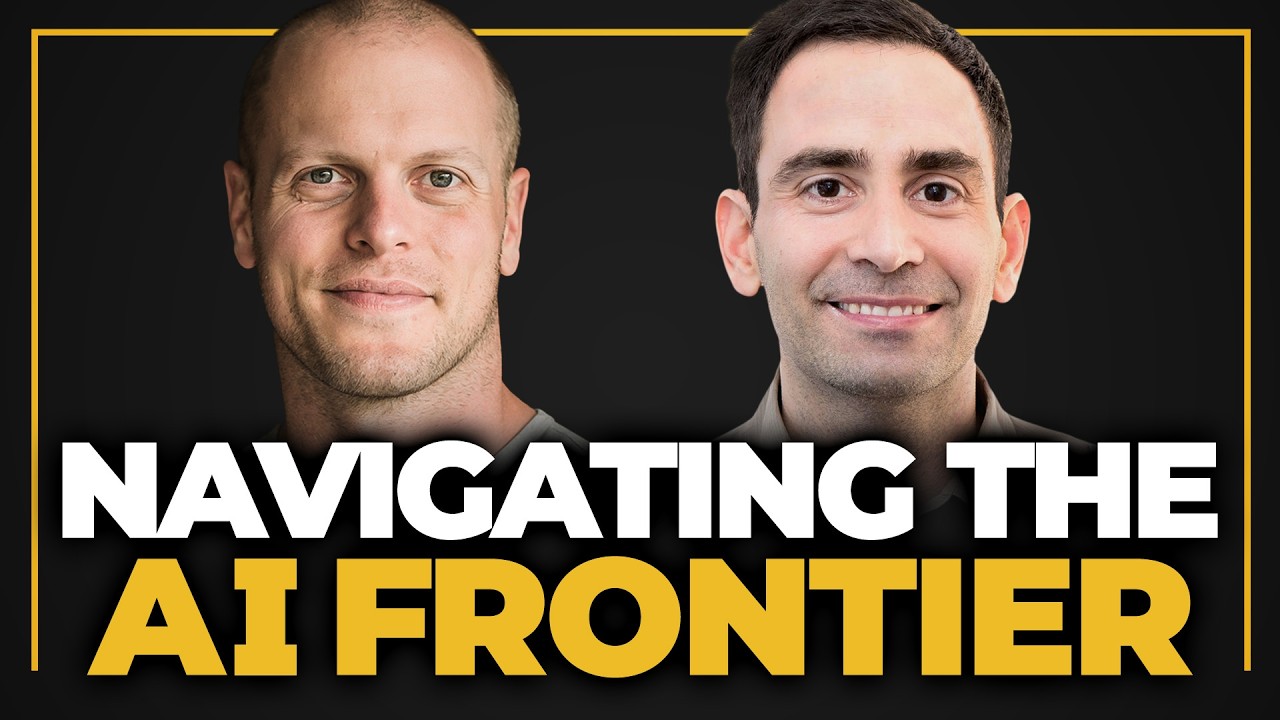
Elad Gil — Investor, entrepreneur, and author of The High Growth Handbook; early backer of OpenAI, Anthropic, Perplexity, Stripe, Airbnb, Coinbase, and Anduril, known for first-principles systems thinking about technology markets.
The gist
Tim Ferriss and Elad Gil discuss the current state of the AI industry, beginning with the talent wars that gave 50-to-few-hundred AI researchers an effective 'personal IPO' and the memory-supply constraints that are temporarily capping how far any single lab can pull ahead. Gil argues AI is forming an oligopoly of labs (OpenAI, Anthropic, Google) aligned with the cloud giants, and that 90-99% of AI companies will eventually fail, so many founders should consider exiting in the next 12-18 months at their value-maximizing moment. He explains his market-first investing philosophy, how he got into early deals organically, his use of SPVs, and the diligence questions that collapse to 'the one thing you need to believe.' The conversation then turns to how he consumes information (X, papers, smart people, AI models) and closes with a wide-ranging exchange on longevity, anesthesia, Ibogaine, and brain stimulation.
Big reveals
- Meta's aggressive bidding plus matching offers from other tech giants gave somewhere between 50 and a few hundred AI researchers the equivalent of an IPO as a class of people spread across Silicon Valley, a 'personal IPO' phenomenon Gil says was last seen with early crypto holders around 2017.
- The current binding constraint on AI is a specific type of memory largely made by Korean companies, expected to last about two years; because every lab is similarly constrained, no single lab can buy 10x the compute, so capabilities should stay roughly close for at least two years.
- Gil argues founders running successful AI companies should take a cold hard look at exiting in the next 12-18 months, citing that 90-95-99% of companies in any tech cycle go bust, and of ~1,500-2,000 internet companies that went public around 2000, only a dozen or two survived.
- Gil predicted in a Substack post about three years ago that the AI model market would be an oligopoly aligned with the clouds, which is roughly what happened; he says it stays an oligopoly unless one lab pulls so far ahead on capabilities it becomes the default.
- His team's unicorn analysis found that 91% of global private AI market cap is concentrated in the Bay Area (a roughly 10-by-10 mile area), with New York a distant second, reinforcing his advice to physically move to an industry's cluster.
- Gil frames generative AI's core shift as moving from selling tools/seats/software to selling work product and human-labor equivalents, which is why previously bad markets like selling to law firms (Harvey) suddenly became viable.
- He distinguishes the founder-limited vs market-limited theories of entrepreneurship and argues AI has thrown open tons of previously closed markets, so any AI company not seeing explosive growth quickly has something fundamentally broken.
Things worth remembering
- An AI model's final output after months of training on a giant cloud is essentially a small flat file, analogous to how 3-4 billion DNA base pairs encode an entire human being.
- OpenAI and Anthropic are each rumored to be around a $30 billion run rate, which Gil notes is roughly 0.1% of US GDP each; if they hit $100 billion they'd approach 1-2% of GDP.
- A chart from Gil's team showed it once took companies like ADP roughly 30 years to reach $1 billion in revenue and Google about four years, while OpenAI and Anthropic did it in about a year.
- With multi-trillion-dollar market caps now common, a company worth $3 trillion can pay $30 billion (1%) for an acquisition, creating unprecedented buying power for big exits.
- Gil cites 2012 (AlexNet) as proof scaling worked, 2017 as when Google invented the transformer architecture (the 'T' in GPT), and ~2020 GPT-3 as the step-function moment he decided AI would be hugely important.
- An analysis (possibly by Yuri Milner) found roughly 100 companies drove ~90% of all tech returns over about two decades, and just 10 companies drove ~80% of returns.
- In the 1970s the four-year stock-option vesting standard arose because companies typically went public within four years; when Google took six years people thought it was shockingly slow.
- Gil cites Coca-Cola redefining its market from 'share of soda' to 'share of liquid sold,' dropping from ~50% to ~0.5% market share, which justified acquisitions like Dasani.
- Autism diagnoses went from roughly one in a few thousand 30-40 years ago to about 3% today, which Gil's deep-dive concluded is driven by shifted diagnostic criteria and incentives rather than older parents; he notes maternal age had a stronger effect than paternal age in some datasets.
- Gil met Noam Shazeer (who started Character.AI then returned to Google) through working with early Google AI researchers, illustrating how smart, polymathic people aggregate together.
Recommended in this episode
Books, products and media the guest or host genuinely endorsed here — with the buy link.
Affiliate link — we may earn a commission at no extra cost to you.
High Growth Handbook
Elad Gil
“But let's turn to the high growth handbook for a second. So that was let's just call it seven-ish years ago. It is an outstanding book.” — Tim Ferriss 00:57:55Find it on Amazon