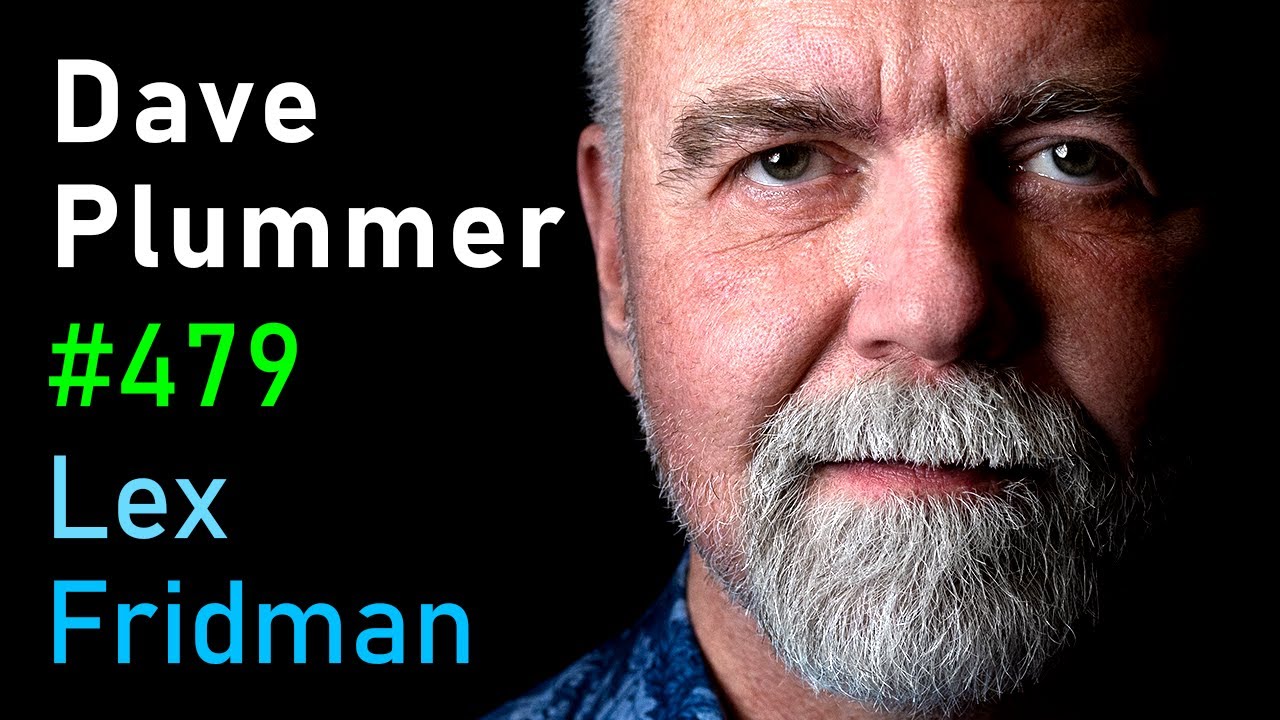
Dave Plummer — A retired old-school Microsoft software engineer who worked on MS-DOS, Windows 95, NT, and XP, creating the Windows Task Manager, ZIP folder support, and the port of Space Cadet Pinball. He now runs the YouTube channel Dave's Garage and wrote a book about life with autism.
The gist
Dave Plummer walks Lex Fridman through his journey from a precocious kid learning on a TRS-80 and Commodore 64 to cold-emailing his way into a Microsoft internship from Saskatchewan. He shares detailed insider stories about porting Windows 95's shell to NT, building the Task Manager as a home side project, adding ZIP support, working under kernel architect Dave Cutler, and implementing Windows XP product activation. The conversation covers the realities of low-level debugging across multiple instruction sets, the craftsmanship-versus-scheduling debates behind Windows UI decisions, and Dave's later software-marketing business that drew a state Attorney General action. The second half is a candid discussion of autism: monotropism, masking, meltdowns, literalism, empathy, and how he reverse-engineers social interactions. He closes with current hobby projects (Tempest RL AI, PDP-11 restoration, GitHub Primes language benchmarks) and reflections on vibe coding and the future of programming.
Big reveals
- Dave's first program was a hand-coded machine-language clone of Galaga on the Commodore 64, which he accidentally destroyed by copying a blank floppy over his only data floppy.
- He got into Microsoft by going through his shareware registration cards, finding a few people with Microsoft email addresses, and cold-emailing them looking for an opportunity, which led to a phone interview and an MS-DOS summer job.
- A bug where Task Manager reported greater than 100% CPU usage turned out to be a kernel accounting issue; Dave put his real phone number into an assert to catch it, and that commented-out number still appears in leaked NT source code today.
- He wrote the original Windows Task Manager at home as a personal side project using registry performance keys, then brought it in-house and switched to internal NT APIs; the original was only about 87K.
- His ZIP folder support began as a home shareware product called Visual ZIP; Microsoft cold-called to acquire it without realizing the author already worked there.
- Microsoft slipped Windows XP product activation and brought it to Dave because of his reputation for fixing things fast, and he cranked it out in time for the XP ship.
- His side software-marketing business spent ~$10,000 in banner ads over a weekend by accident but generated ~$38,000 in sales; it later drew a Washington State AG action over nag-screen frequency and default disc-shipping charges.
- At his first intern summer, Dave interrupted his manager introducing him to Bill Gates to correct that a feature took three months, not four, illustrating how autistic literalism shaped his career interactions.
Things worth remembering
- Dave ranks IBM's OS/360 as the most impactful operating system ever, above Windows 95, because COBOL programs from 1962 can still run on modern IBM mainframes.
- He notes that Dave Cutler, the architect of the NT kernel (the 'Linus of Windows'), is around 85 and still codes every day as a Microsoft Fellow.
- Debugging at Microsoft was done in raw assembly across four instruction sets (Intel, MIPS, Alpha, PowerPC) with no source-level debugging.
- The blue screen of death's white-on-blue color scheme came from author John Vert's MIPS firmware and Visual SlickEdit editor using the same colors, letting him code, boot, crash, and reboot in one scheme.
- Dave essentially reinvented Hamming code unknowingly to make Task Manager repaint only the individual dirty cells, enabling very fast, smooth resizing.
- Modern Space Cadet Pinball physics differ slightly from the Windows 95 version because Dave's port interpolates physics up to ~5,000 frames per second instead of ~30.
- The Windows Task Manager is reportedly used by around two billion people a month.
- Slot machines determine the win or loss via a random number generator first, then fabricate the reel animation to fit, rather than spinning reels and reading the result.
- In the 1970s-80s a Vegas slot-machine tech burned his own backdoored ROMs and invoked them on return service visits.
- In Dave's GitHub Primes benchmark comparing prime-sieve implementations across ~100 languages, Zig currently leads, with C running roughly 1.5x as long as Zig.
Recommended in this episode
Books, products and media the guest or host genuinely endorsed here — with the buy link.
Affiliate link — we may earn a commission at no extra cost to you.
Secrets of the Autistic Millionaire
Dave Plummer
“he wrote a book on autism and about his life story, called Secrets of the Autistic Millionaire, where he gives really interesting insights” — Lex Fridman 00:00:30Find it on Amazon
Hard Drive: Bill Gates and the Making of the Microsoft Empire
James Wallace and Jim Erickson
“I'm reading a book that I had bought called Microsoft, or Bill Gates, and the Making of Microsoft Hard Drive... And it's a great book.” — Dave Plummer 00:11:38Find it on Amazon
3D Pinball: Space Cadet
Cinematronics
“Why is that game so awesome? - I think it's a great design... the original game is a great design.” — Dave Plummer 00:43:53Find it on Amazon
Cursor
Anysphere
“Yeah, I've done a ton of it for the Python side... I found it very helpful because I've learned a lot from watching the code that it generates” — Dave Plummer 00:44:53Find it on Amazon