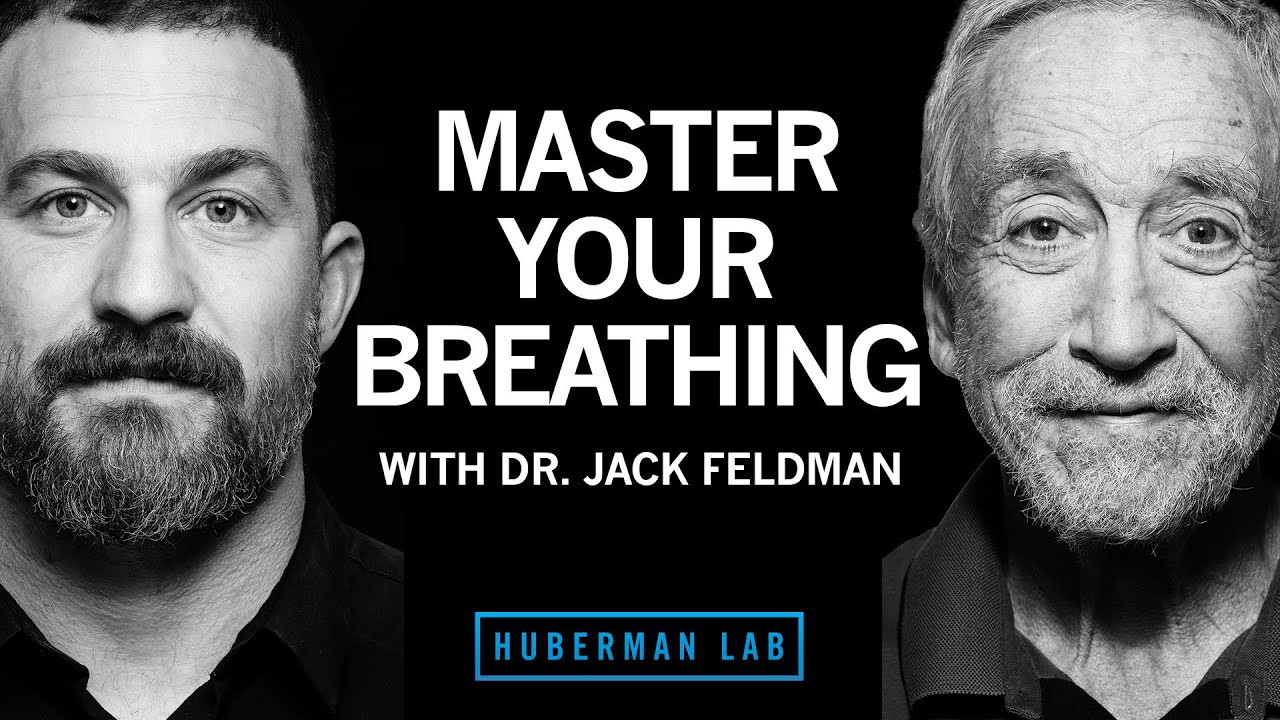
Dr. Jack Feldman — A distinguished professor of neurobiology at UCLA and a pioneer of the neuroscience of breathing. He discovered the pre-Botzinger complex and the second brainstem oscillator that generate the patterns of breathing.
The gist
Andrew Huberman interviews Dr. Jack Feldman about the brain mechanisms that generate and control breathing. Feldman explains the two brainstem oscillators behind inhalation and active exhalation, the role of the diaphragm, and why we sigh roughly every five minutes to keep our lungs from collapsing. The conversation explores the bidirectional relationship between breathing and brain state, covering physiological sighs, emotional vs. volitional control of breath, episodic hypoxia, and how slow breathing reduced fear in mice as much as an amygdala manipulation. They close with practical breathwork advice and Feldman's interest in magnesium threonate for cognitive function.
Big reveals
- Feldman is credited with founding the field of how the brain controls breathing, discovering the major brain centers that generate breathing patterns.
- He reveals he initially made a fundamental mistake assuming one oscillator controlled all breathing, then discovered a second oscillator driving active expiration.
- Injecting Bombesin into the pre-Botzinger complex of rats spiked their sigh rate from 20-30 per hour to 500 per hour.
- Ablating the specific sigh-generating cells caused rats' health to deteriorate so badly the animals had to be sacrificed.
- Mice trained to breathe slowly 30 minutes a day for four weeks froze far less in a fear test, comparable to a major amygdala manipulation.
- A locked-in syndrome patient could not voluntarily change breathing on command, but his breathing changed instantly when he laughed at a joke, proving a separate emotive breathing pathway.
- In a placebo-controlled human trial, magnesium threonate improved cognitive age by eight years on average versus two years for placebo.
Things worth remembering
- If laid flat, your lung alveoli would cover about 70 square meters, roughly a third of a tennis court.
- The diaphragm only needs to move about two-thirds of an inch to move enough air for a full breath.
- Humans sigh about every five minutes, and most people guess wrong by two orders of magnitude.
- Sighs exist to pop open collapsing fluid-lined alveoli; in the polio iron-lung era, adding periodic big breaths sharply cut mortality.
- One breath of about 500 milliliters raises blood oxygen partial pressure from 40 to 100 millimeters of mercury.
- Vagus nerve stimulation can relieve refractory depression, hinting the natural breathing rhythm it carries plays a role in brain processing.
- Episodic hypoxia (alternating low and normal oxygen) raises ventilation and improves motor and cognitive function for hours.
- Almost everything in the brain and body is modulated by breathing, including heart rate, pupil size, fear response, and reaction time.
- Raising magnesium in the bath strengthened long-term potentiation in neurons by lowering background electrical noise.
- Magnesium threonate crosses the gut-blood barrier far better than standard magnesium salts, which cause diarrhea.
Recommended in this episode
Books, products and media the guest or host genuinely endorsed here — with the buy link.
Affiliate link — we may earn a commission at no extra cost to you.
The Diving Bell and the Butterfly
Jean-Dominique Bauby
“There's a great book called "The Diving Bell and the Butterfly" about a young man who this happens to” — guest 01:13:45Find it on Amazon
Magnesium L-Threonate (Magtein / Neurocentria)
Neurocentria
“I need to disclose that I am a scientific advisor to a company called Neurocentria, which my graduate student, Guosong Liu is CEO.” — guest 02:07:58Find it on Amazon