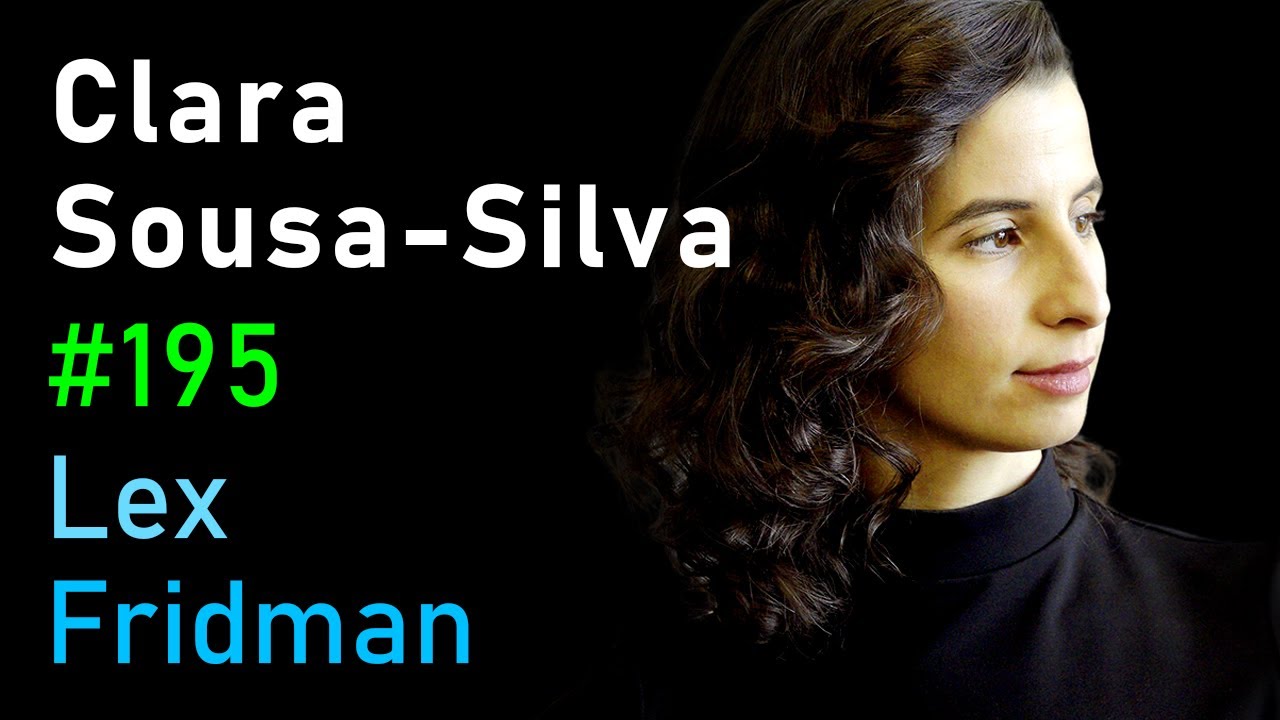
Clara Sousa-Silva — A quantum astrochemist at Harvard specializing in the spectroscopy of gases that could be signs of life on other planets. She co-authored the 2020 paper reporting phosphine in Venus's atmosphere, a possible biosignature.
The gist
Clara Sousa-Silva walks through the science and saga of the 2020 phosphine detection on Venus, explaining how spectroscopy lets us read molecules in distant atmospheres and why phosphine is such a compelling, hard-to-fake sign of life. She describes simulating phosphine's 16.8 billion spectral transitions, her faster approximate tool RASCAL for cataloging 16,000 unknown molecules, and the role of computation and machine learning. The conversation ranges into whether aliens have visited (she bets firmly no, citing interstellar distances and scientists' inability to keep secrets), the likelihood of life versus intelligent life, and the destruction-and-rebirth cycles of planetary systems. It closes on collaboration, productivity, programming, and her view that the universe has no meaning, which she finds liberating rather than depressing.
Big reveals
- She admits 'the short answer is we don't know' about Venus phosphine, with data so noisy they aren't even sure the signal is real.
- Phosphine has 16.8 billion spectroscopic ways to rotate and vibrate, and they found just one of those marks on Venus.
- Replicating her phosphine spectral work for every needed molecule would take her over 62,000 years.
- She bets everything humanity hasn't been visited because no military could contain such beings and scientists can't keep secrets.
- She says intelligent alien life is 'deeply unlikely,' possibly not even plausible, and would bet against it.
- She believes life itself is inevitable and therefore common, likely 'everywhere in the galaxy.'
- She argues she'd rather hire a programmer who barely knows astronomy than teach a scientist to program.
- She finds 'enormous relief in the absence of meaning,' calling the search for cosmic meaning a human projection.
Things worth remembering
- Every molecule has a unique spectroscopic fingerprint; phosphine's signal on Venus sat at 8.904 wavenumbers.
- At the telescope's resolution only two molecules absorb at that frequency: phosphine and sulfur dioxide (SO2).
- Phosphine was used as a chemical warfare agent in World War I and more recently by ISIS.
- Diphosphines have been described as smelling like garlicky fishy death, or 'the rancid diapers of the spawn of satan.'
- Phosphine is so hard to make that life must sacrifice energy to produce it, making it a strong biosignature.
- She built RASCAL (Rapid Approximate Spectral Calculations for All) to quickly approximate spectra for all 16,000 molecules.
- She jokes that human TV signals are a more robust sign of life than oxygen, and CFCs would be unambiguous aliens.
- Across roughly five billion species in Earth's history, intelligent life arose only once and for a blink of an eye.
- White dwarf systems can settle into stable orbits for billions of years, potentially allowing life to begin again.
- She learned MATLAB, Java, Fortran, and IDL before switching to Python 'like a normal person.'
Recommended in this episode
Books, products and media the guest or host genuinely endorsed here — with the buy link.
Affiliate link — we may earn a commission at no extra cost to you.
Contact
Carl Sagan
“when i was little it was contact the book the carl sagan book i really thought i was just like ellie” — guest 01:50:18Find it on Amazon