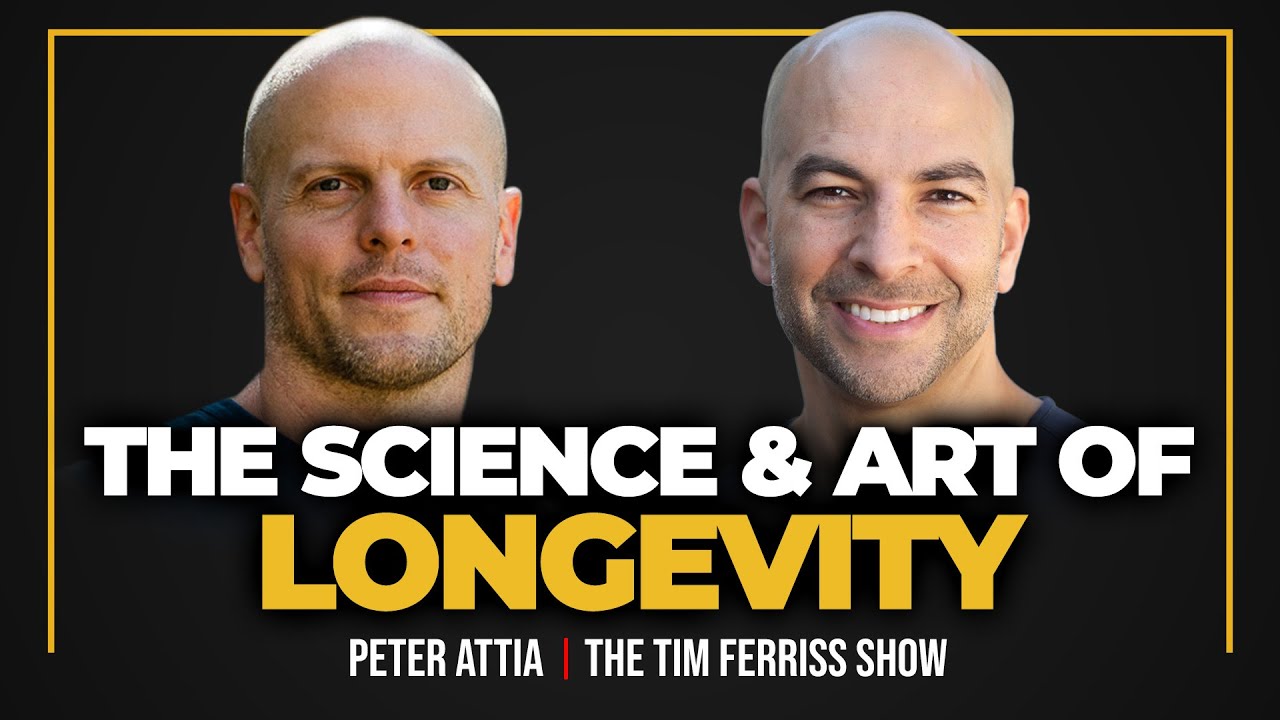
Dr. Peter Attia — Physician focused on longevity and healthspan, founder of Early Medical, and author of the book Outlive: The Science and Art of Longevity.
The gist
Tim Ferriss interviews Dr. Peter Attia about the central ideas in his book Outlive. Attia explains why he deliberately rebuilt muscle mass after extreme fasting cost him lean tissue, and lays out his protein, exercise, and metric-tracking strategies. The conversation works through his Medicine 2.0 versus Medicine 3.0 framework, the objective-strategy-tactics approach, and why prevention and medical literacy matter more than reactive treatment. They dig into the highest-leverage longevity levers (VO2 max and strength), tools like continuous glucose monitors, aggressive early cancer screening, and finally the often-overlooked role of emotional health.
Big reveals
- After years of aggressive fasting (up to 10-day water-only fasts, routine 7-day fasts quarterly), Attia was shocked by a DEXA scan showing how much muscle he had lost over a decade.
- He regained roughly 13-14 pounds of lean mass in about 12 months without anabolic steroids by prioritizing protein, timing, and hypertrophy training.
- His 'death bars' analysis: if you are over 40 and don't smoke, about 80% chance you die from atherosclerotic cardiovascular disease, cancer, neurodegenerative disease, or metabolic disease.
- VO2 max and muscular strength stand 'in a league of their own' for longevity, outweighing the downside risk of conditions like diabetes, obesity, smoking, and high blood pressure.
- Moving from the bottom 25% to the 25th-50th percentile of fitness cuts all-cause mortality risk roughly in half, with no drug matching that effect.
- After a 6-9 month deep dive, exercise emerged as the single most important modifiable behavior to reduce risk of Alzheimer's, Parkinson's, and Lewy body dementia.
- Treating cancers caught early produces vastly better outcomes than the same cancer caught late: ~80%+ ten-year survival for resected early colon cancer versus very few surviving five years with metastatic disease.
- Attia reveals he spent time in a rehabilitation center where, on day 19, he had a breakthrough that let him finally write 47 self-affirmations he then read twice daily for six months.
Things worth remembering
- Attia targets about 1 gram of protein per pound of body weight, spread across servings of roughly 20-50 grams to avoid gluconeogenesis and maximize muscle protein synthesis.
- He tracks his eating with an app called Carbon, focusing on hitting leucine, lysine, and methionine targets (about 6-8g leucine, comparable lysine, at least 2g methionine daily).
- Attia no longer uses BCAAs during workouts (just an electrolyte drink) and relies on high-quality whey protein post-workout instead.
- Despite the 1971 War on Cancer aiming to eradicate the disease by 1976, cancer survival is barely 5% better than it was in 1970.
- A hemoglobin A1C of 6.5% corresponds to an average blood glucose of about 140 mg/dL; lower average glucose correlates with lower all-cause mortality even in non-diabetics.
- Attia wants patients able to carry half their body weight in each hand for one minute; grip strength repeatedly correlates with longevity and lower dementia risk.
- He rucks with 55-60 pounds, recommending beginners start at one-sixth to one-third of body weight; Michael Easter's The Comfort Crisis notes the military caps useful loads around a third.
- For VO2 max, spend about 80% of aerobic time in zone two (long, slow) and the rest in zone five intervals of 3-8 minutes, like a four-by-four workout once a week.
- Key biomarkers Attia tracks: apoB, Lp(a), APOE genotype, uric acid, homocysteine, insulin, liver function, and Cystatin C (which he calls far more accurate than creatinine for kidney function).
- On the GRAIL liquid biopsy, early-stage sensitivity is only ~20% overall, but jumps to ~75% for aggressive hormone-negative (triple negative) breast cancer, suggesting it detects cancer behavior, not just presence.
Recommended in this episode
Books, products and media the guest or host genuinely endorsed here — with the buy link.
Affiliate link — we may earn a commission at no extra cost to you.
Carbon (nutrition tracking app)
Carbon Diet Coach
“Yeah, it's called Carbon. I have no affiliation with it, but a friend of mine, it's his app and I like it.” — Dr. Peter Attia 00:10:01Find it on Amazon
Carbon (nutrition tracking app)
Carbon Diet Coach
“And I use an app to track what I'm eating just so that I can see where my protein is coming from and how much I'm getting.” — Dr. Peter Attia 00:09:27Find it on Amazon
Whey protein
“So instead, today I just use high-quality whey protein post-workout, and I don't trouble myself with consuming any protein in workout.” — Dr. Peter Attia 00:11:36Find it on Amazon
Outlive: The Science and Art of Longevity
Dr. Peter Attia
“So let's come to the book. So you and I have had many offline conversations about the book.” — Dr. Peter Attia 00:12:46Find it on Amazon
The 4-Hour Body
Tim Ferriss
“but when I published The 4-Hour Body, and no doubt you're going to get a lot of these types of requests” — Tim Ferriss 00:21:22Find it on Amazon
The Drive (podcast)
Dr. Peter Attia
“I would say if people started with your AMA number 30, this is episode 188, How to Read and Understand Scientific Studies.” — Tim Ferriss 00:45:45Find it on Amazon
Studying Studies (blog series)
Dr. Peter Attia
“Now, we did write a series six years ago, I think, called Studying Studies, which is I think a five-part blog series that Bob Kaplan and I wrote.” — Dr. Peter Attia 00:41:55Find it on Amazon
AMA #30 / Episode 188: How to Read and Understand Scientific Studies
Dr. Peter Attia
“I would say if people started with your AMA number 30, this is episode 188, How to Read and Understand Scientific Studies. If people listen to that first” — Tim Ferriss 00:45:45Find it on Amazon
Bad Science
Ben Goldacre
“And if they... read a book like Bad Science by Ben Goldacre, who's an MD. British, so some of the cultural context and examples may not resonate” — Tim Ferriss 00:46:16Find it on Amazon
How to Lie With Statistics
Darrell Huff
“There's a book called How to Lie With Statistics by Darrell Huff, which I think is a very fast read.” — Tim Ferriss 00:55:04Find it on Amazon
GORUCK (rucking backpacks)
GORUCK
“So yeah, the GORUCK is the way to go here... if you want to invest in it, they make amazing packs.” — Dr. Peter Attia 01:40:02Find it on Amazon
The Comfort Crisis
Michael Easter
“I think Michael Easter, who's written about this extensively in his book The Comfort Crisis... The Comfort Crisis, I can't recommend highly enough.” — Dr. Peter Attia 01:42:44Find it on Amazon
Cystatin C (kidney function blood test)
“Cystatin C is one that I think is largely underappreciated. So most doctors are using creatinine as the measure of kidney function. Creatinine is a joke.” — Dr. Peter Attia 01:55:14Find it on Amazon
Outlive: The Science and Art of Longevity
Dr. Peter Attia
“The book is Outlive: The Science and Art of Longevity. I never say this, long-term listeners will know this, go get the book.” — Tim Ferriss 02:13:36Find it on Amazon