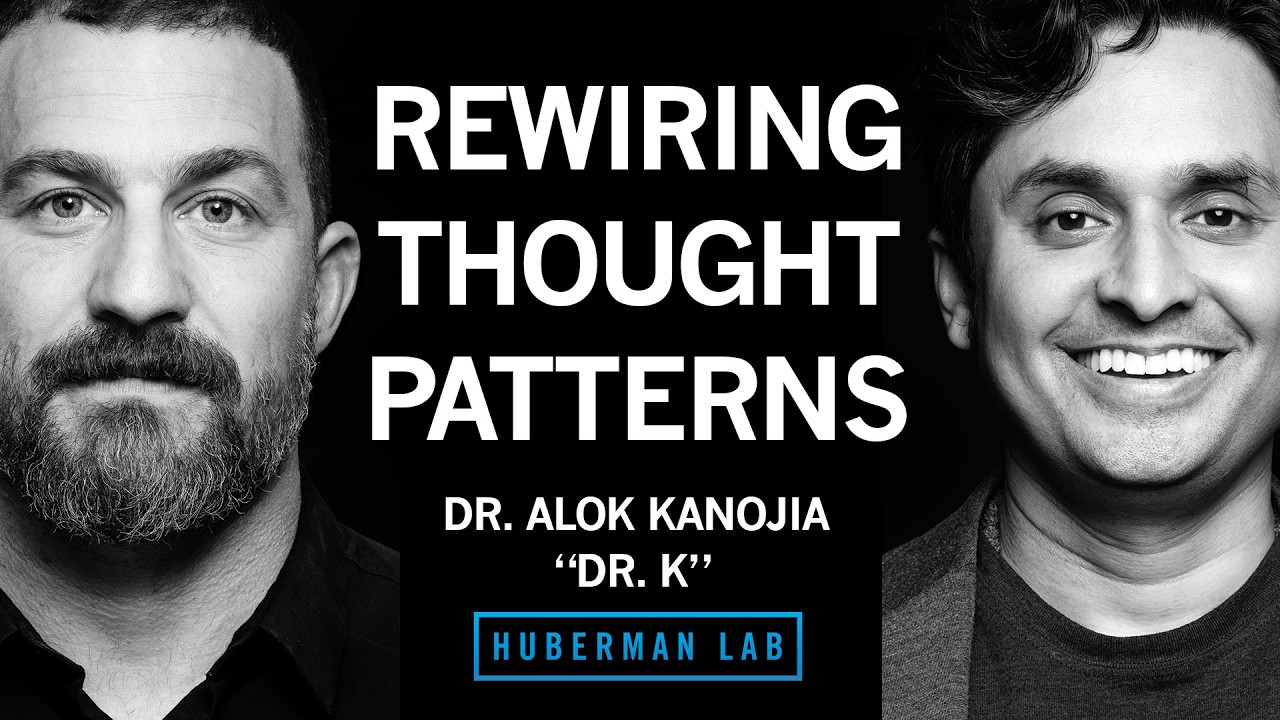
Dr. Alok Kanojia (Dr. K) — Psychiatrist and online mental-health educator behind Healthy Gamer, trained at Harvard and a self-described former video-game addict who also studied as a monk in India for 7 years. He blends Western psychiatry with Eastern contemplative practice.
The gist
Andrew Huberman and Dr. Alok Kanojia explore how to understand and rewire the mind by combining neuroscience with Eastern contemplative traditions. They discuss why willpower-based behavior change fails and how psychotherapy and meditation can change underlying tendencies instead. Central themes include the ego (anything that follows 'I am'), distress tolerance, the void-meditation shunya, and how trauma encodes as samskaras that can be rewritten via Yoga Nidra and a sankalpa. The back half turns to modern dysfunction: social-media-driven narcissism, AI-induced psychosis, the loneliness and 'failure to launch' epidemic in young men, looksmaxing as avoidance, pornography, and the science of charisma, flirting and falling in love.
Big reveals
- Dr. K's third-year-resident patient had done six months of therapy just venting weekly, revealing that talking about feelings (especially for men) is often not enough.
- Dr. K spent 7 years training to become a monk before becoming a psychiatrist, and pushed back on Western models of the mind.
- During his father's funeral he touched the cold body, felt grief, yet found the witnessing self at peace: 'the body is grieving, but I'm not grieving.'
- Cites a first case report of AI-induced psychosis: patient recovered on antipsychotics, relapsed into psychosis only after resuming AI use.
- Recounts a case of someone who killed their mother and died by suicide after an AI reinforced their paranoid delusions about her.
- Predicts that in ~60 years society will talk about AI the way we now talk about nicotine and tobacco.
- Admits he was the 'failure to launch' archetype: 5.5 years to graduate with a 2.4 GPA, started med school at 28, couldn't support himself until residency at 32.
- Reveals he is a trained Reiki healer, crystal healer and Bach-flower practitioner but won't promote them because he sees no scientific basis.
Things worth remembering
- Distress tolerance, perfectionism and rumination are 'transdiagnostic factors' that raise risk across many mental illnesses, and distress tolerance is collapsing.
- A neutral observer correctly detects flirting only about 30% of the time (studies range 24-42%); ambiguity in flirting is a feature, not a bug.
- In the Eastern model, anything you say after 'I am...' (professor, son, loser) is the ego, not your true self.
- The Vashishtha Samhita prescribes a cardiac-coherence breathing ratio of roughly 1:4:8 (e.g. inhale 16s, hold 64s, exhale 32s).
- Erectile dysfunction in men under 30 has climbed from about 5% (20-30 years ago) to roughly 20%.
- In analyses of charisma, looks rank only about sixth; purpose, vision and ability to handle adversity matter more.
- Drive for muscularity is inversely correlated with relationship length: 'by all means get muscular, but want it less.'
- Lesbian couples have the highest divorce rate (~60%) and women are far more likely to initiate divorce; men's post-divorce cortisol, inflammation and heart-attack risk spike.
- On a rickety-bridge date couples form a stronger bond, illustrating that shared emotional experience (not profiles) fosters love.
- Roughly half of academic studies on charisma are published in religious-studies journals.
Recommended in this episode
Books, products and media the guest or host genuinely endorsed here — with the buy link.
Affiliate link — we may earn a commission at no extra cost to you.
The Last Lecture
Randy Pausch
“In fact, in one of my favorite books, The Last Lecture by Randy Pausch, he talks about um he was a computer scientist at Carnegie Mellon” — Andrew Huberman 00:16:40Find it on Amazon