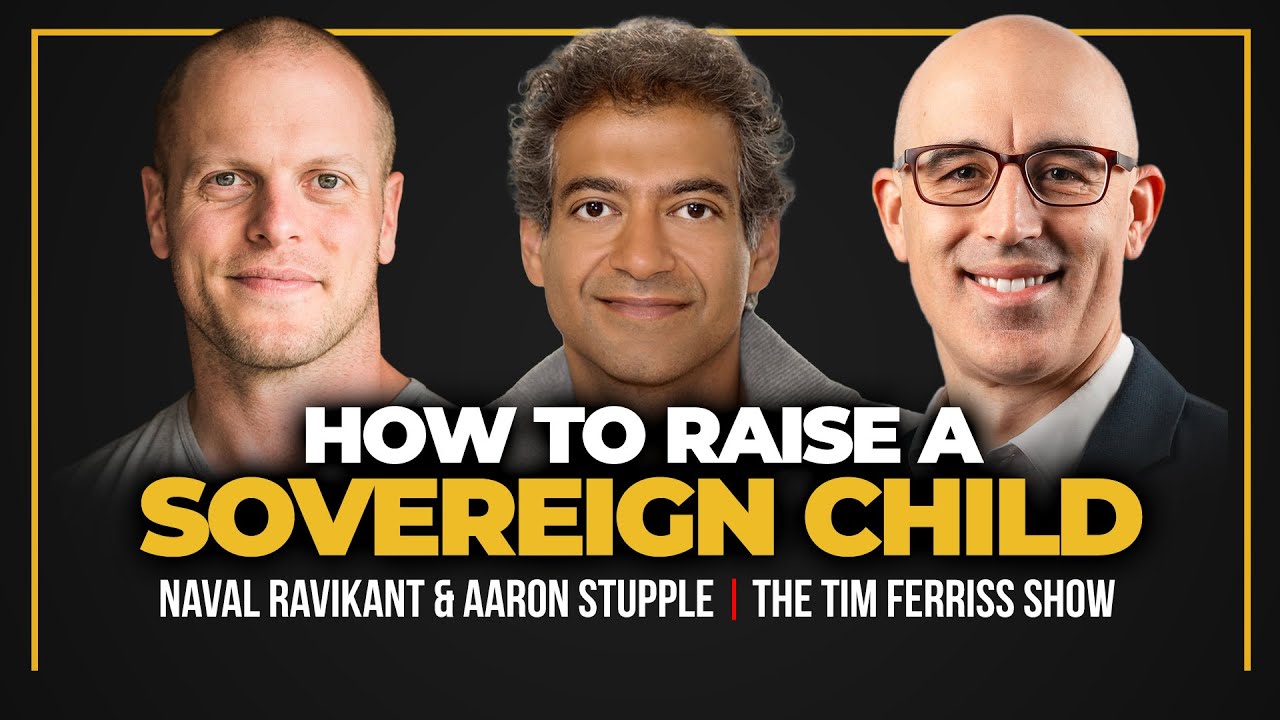
Naval Ravikant and Aaron Stupple — Naval Ravikant is an entrepreneur and investor; Aaron Stupple is a physician (internal medicine hospitalist), former public school teacher, father of five, and author of The Sovereign Child, espousing the 'taking children seriously' philosophy. Hosted by Tim Ferriss.
The gist
Tim Ferriss hosts Naval Ravikant and Aaron Stupple to debate 'taking children seriously,' a non-coercive parenting philosophy rooted in David Deutsch and Sarah Fitz-Claridge's work. Stupple, a father of five practicing it for seven years, argues kids are knowledge creators whose interests should be cultivated, not foiled by arbitrary rules around sleep, food, screens, school, and chores. Naval, more skeptical, says he has adopted roughly 30-50% of it but holds the line on math, reading, and physical safety. They explore why coercion damages the parent-child relationship, how to solve problems creatively instead of imposing rules, the value of opt-out-able constraints, unschooling outcomes, and resilience through passion. The episode closes with Stupple's practical tips for navigating the emergency room and hospital.
Big reveals
- Stupple's family practices no sleep schedules, unrestricted screen time, no forced school, no chores, no forced sharing, no forced teeth-brushing, and no punishments or timeouts.
- Stupple argues every time you force a child to do something, you inevitably set yourself up as an adversary, which confuses the child about the actual reason behind the behavior.
- Naval reveals he is restrictive in only two areas: insisting on math and reading ('until then you're a little slave'), and stopping kids from hitting each other.
- Stupple reframes knowledge itself as constraint, arguing that as knowledge progresses constraints get tighter, and good constraints are ones you can opt out of.
- Naval claims mandatory public education originated as forced assimilation during empires, with conquered peasants hiding children to keep them from school.
- Stupple lays out four categories of harm caused by rules: adversarial gatekeeping, damage to self-relationship/self-confidence, confusion about the actual issue, and a conformist deference to authority.
- Stupple's top ER survival tip: bring multiple copies of an accurate medication list, because the hospital's records almost never match what the patient actually takes.
Things worth remembering
- Aaron Stupple has five kids ages 7 to 1; Naval was joking when he said Aaron has zero children.
- Historically children hit puberty around age 8-12 and were treated as adults; the move to adulthood at 18 is recent.
- Summerhill, a famously permissive UK school where kids decided whether to attend class and ran the school, is cited as an institutional version of this philosophy.
- Homeschooled kids reportedly run one to two years ahead of private school kids, and unschooled kids who decide to attend college can catch up in about one year.
- Stupple once dumped a whole bag of lollipops on the floor for his three-year-old, who licked about 20, got bored, and abandoned them, learning lollipops get gross.
- Stupple cites Judith Rich Harris's meta-research concluding child outcomes are mostly genetic, with the nurture portion driven by peers rather than parents.
- The creator of Settlers of Catan, Klaus Teuber, refined the game because his family could opt out and leave when bored, illustrating opt-out-able constraints.
- Naval notes high-achiever biographies often feature huge amounts of unstructured free time, citing Newton whittling water wheels by a creek.
Recommended in this episode
Books, products and media the guest or host genuinely endorsed here — with the buy link.
Affiliate link — we may earn a commission at no extra cost to you.
The Sovereign Child: How a Forgotten Philosophy Can Liberate Kids and Their Parents
Aaron Stupple
“Aaron actually wrote a book called The Sovereign child he's been espousing a theory around taking children seriously” — Naval Ravikant 00:03:08Find it on Amazon
The Sovereign Child: How a Forgotten Philosophy Can Liberate Kids and Their Parents
Aaron Stupple
“Erin so the book is The Sovereign child subtitle how a forgotten philosophy can liberate kids and their parents” — Tim Ferriss 02:11:17Find it on Amazon
The Beginning of Infinity
David Deutsch
“all of this comes down from Deutsch's philosophy so beginning of infinity fabric of reality great books” — Aaron Stupple 02:09:14Find it on Amazon
The Fabric of Reality
David Deutsch
“so beginning of infinity fabric of reality great books although they don't explicitly talk about children” — Aaron Stupple 02:09:14Find it on Amazon
Settlers of Catan
Klaus Teuber
“I like board games and settlers of Katan I love that game and what happened was the creator of that game some German guy clous toyba” — Aaron Stupple 01:56:41Find it on Amazon
The Body Electric (TED Radio Hour miniseries)
NPR / TED Radio Hour
“there's a TED Radio Hour miniseries it's podcast uh one of which in a series called The Body Electric focuses on sort of maladaptive changes in the optic system” — Tim Ferriss 02:01:27Find it on Amazon