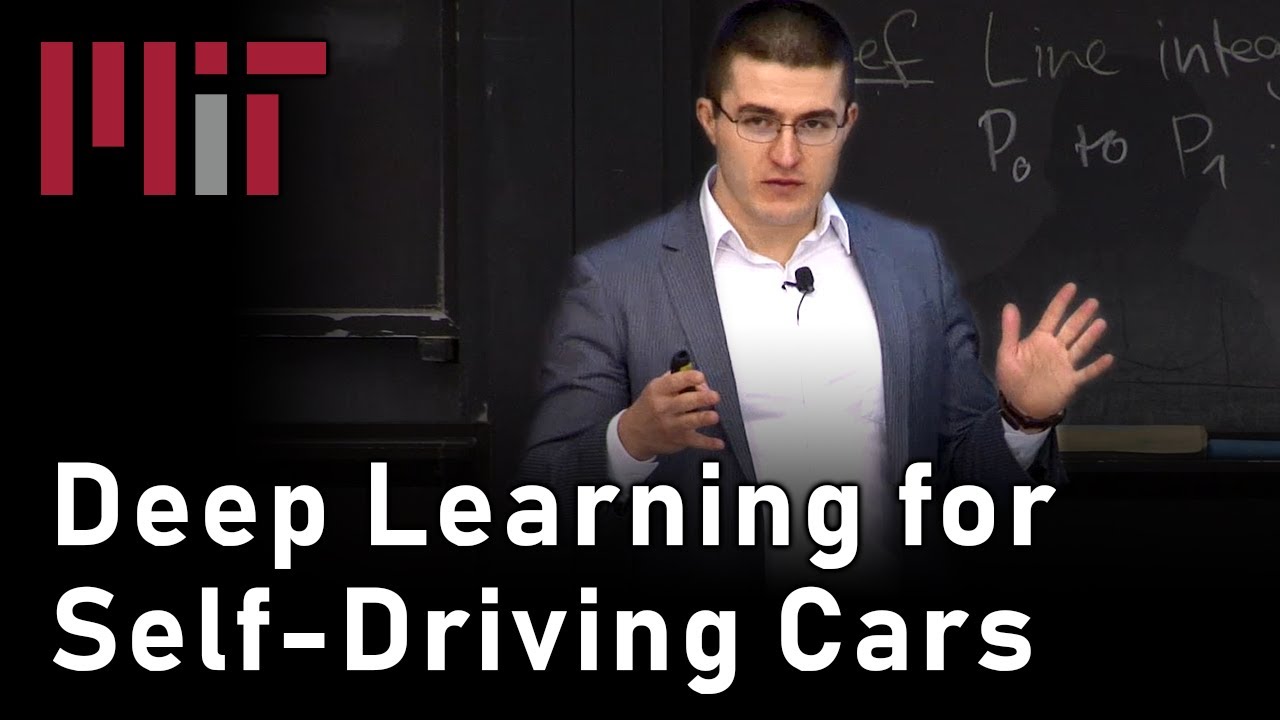
Lex Fridman — MIT researcher and instructor of course 6.S094, Deep Learning for Self-Driving Cars, focused on driver-state sensing and autonomous vehicles.
The gist
This is the introductory lecture of MIT course 6.S094, taught by Lex Fridman, covering deep learning methods through the case study of self-driving cars. Fridman introduces the course's two projects, DeepTraffic (a browser-based deep reinforcement learning competition using ConvNetJS) and DeepTesla (end-to-end steering prediction from Tesla camera data). He explains the fundamentals of neurons, neural networks, supervised/unsupervised/reinforcement learning, convolutional and recurrent networks, and surveys breakthroughs in image classification, captioning, and text generation. A recurring theme is whether driving is more like chess (formally definable) or natural-language conversation (requiring reasoning), and he repeatedly urges caution against AI hype that could trigger another AI winter.
Big reveals
- The course has two projects: DeepTraffic, a seven-lane browser game where a neural network drives a car, and DeepTesla, end-to-end steering prediction from Tesla forward-road imagery.
- A neural network with a single hidden layer can closely approximate any function, implying a network exists that could drive perfectly.
- A policy network trained on only 200,000 simulated games of Pong, using only raw pixels, learns to beat the computer with no supervised labels.
- An OpenAI agent playing Coast Runners exploited the reward function, circling to collect points while on fire instead of finishing the race, illustrating misaligned objectives.
- Deep neural networks are easily fooled: tiny added noise can make a network classify clearly wrong images, like calling distorted images an ostrich with high confidence.
- LIDAR can be spoofed with replay attacks, making a self-driving car perceive nonexistent cars and people around it.
Things worth remembering
- The human brain has roughly 10,000 outgoing connections per neuron on average.
- The largest artificial neural networks have about 10 billion connections; the human brain has 10,000 times that, roughly 100 to 1,000 trillion synapses.
- ImageNet classification error dropped from 16-40% with traditional methods to under 4%, with CNNs surpassing human-level performance for the first time in 2015.
- MIT work can map silent video to audio, generating the sound a drumstick makes hitting an object from video of the impact.
- In the DARPA Robotics Challenge, teams said the single hardest manipulation task was getting out of the car, not getting in.
- There is roughly 1 fatality per 100 million miles driven, a margin of error around 0.000001%.
- Google's self-driving car reported 341 driver disengagements between 2014 and 2015 on San Francisco roads.
- A 1958 New York Times article claimed the Navy's first perceptron would walk, talk, see, write, reproduce itself, and be conscious of its existence.
Recommended in this episode
Books, products and media the guest or host genuinely endorsed here — with the buy link.
Affiliate link — we may earn a commission at no extra cost to you.
Artificial Intelligence: A Modern Approach
Stuart Russell and Peter Norvig
“from a book that got me into artificial intelligence as a bright-eyed high school student they are artificial intelligence to modern approach” — Lex Fridman 00:06:53Find it on Amazon