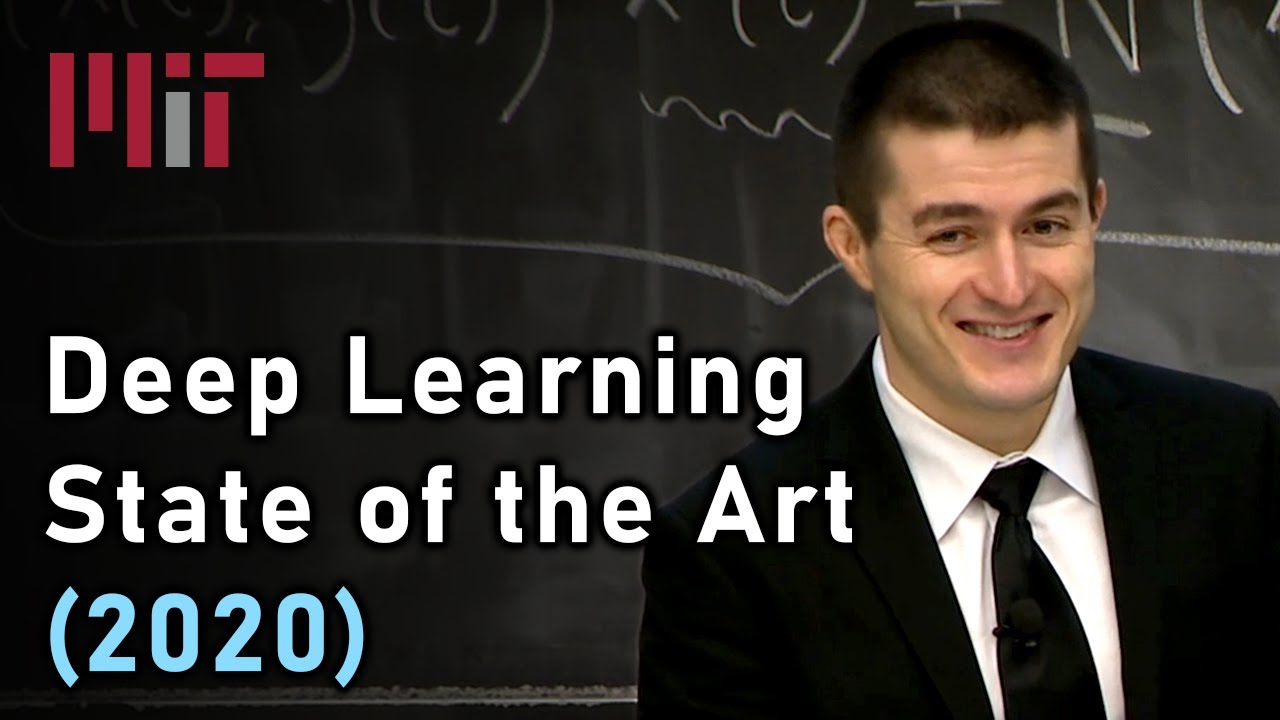
Lex Fridman — MIT researcher, lecturer, and AI podcast host who teaches a popular deep learning lecture series and works on autonomous driving and human-centered AI.
The gist
This is the 2020 State of the Art lecture in Lex Fridman's MIT deep learning series, recapping the major advances of 2017-2019. He surveys the maturing of TensorFlow and PyTorch, the transformer explosion (BERT, XLNet, GPT-2, Megatron), reinforcement learning milestones (OpenAI Five in Dota 2, AlphaStar in StarCraft, Pluribus in poker, the Rubik's Cube hand), and the two competing autonomous-vehicle philosophies of Waymo and Tesla. He frames recurring themes of self-play, active learning, common-sense reasoning, and the under-discussed power of recommendation systems. The talk closes with audience Q&A on AGI, machine emotions, ethics, and who will ultimately control AI.
Big reveals
- 2019 was the first year it became cool to highlight the limits of deep learning, with books and press declaring 'the era of deep learning is over.'
- Reflecting on the GPT-2 staged-release scare, he argues humans turned out to be more dangerous than the AI, but the thought experiment was valuable.
- He contrasts the two AV approaches: for Waymo deep learning is 'the icing on the cake,' but for Tesla 'deep learning is the cake.'
- He claims recommendation systems are the most powerful and impactful AI of the coming decades yet are barely discussed publicly.
- Asked if machines will think and feel, he answers '100 percent yes' because the display of emotion is emotion to him.
- He predicts the first time a product says 'please don't hurt me' with a straight face is when torturing AI becomes unethical.
- His real worry is not AI as our masters but owners of large tech companies using AI to control humans.
- He stresses self-play, where agents learn by competing against incrementally better versions of themselves, as one of deep learning's most exciting ideas.
Things worth remembering
- January 1st 2020 marked the end of Python 2 support in TensorFlow and PyTorch.
- OpenAI Five consumed 800 petaflop/s-days and experienced about 45,000 years of Dota self-play over 10 real-time months.
- The 2019 OpenAI Five had a 99.9 percent win rate against the 2018 version.
- AlphaStar reached Grandmaster in StarCraft in 2019 by using a camera and the same constraints humans face.
- The lottery ticket hypothesis shows small sub-networks inside a large network can match its full accuracy.
- A best-paper result at ICML 2019 proved disentangled representations are impossible without inductive biases.
- Waymo logged about 20 million real-world miles and 10 billion simulated miles by that year.
- Poker pros described Pluribus as extremely hard to read, excelling at thin value bets and mixed strategies humans struggle to execute.
- Fridman believes more data, bigger networks, and better data selection will take us further than hybrid symbolic approaches.
- He originally wanted to be a psychiatrist to engineer the human mind, then learned to program in C++ at age 12.
Recommended in this episode
Books, products and media the guest or host genuinely endorsed here — with the buy link.
Affiliate link — we may earn a commission at no extra cost to you.
Deep Learning
Yoshua Bengio, Ian Goodfellow, Aaron Courville
“the three books I recommend of course learning book by yoshua bengio and good fellow and erinkoval that's more sort of the fundamental thinking” — Lex Fridman 01:09:09Find it on Amazon
Grokking Deep Learning
Andrew Trask
“grokking deep learning which Andrew Trask will be here Wednesday his book grokken deep learning I think is the best for beginners book on deep learning I love it” — Lex Fridman 01:09:09Find it on Amazon
Deep Learning with Python
Francois Chollet
“Francois Sholay the best book on Keros in tensorflow and really deep learning as well as as deep learning with python” — Lex Fridman 01:09:41Find it on Amazon